ARTICLE / UPDATED JUNE 2026
Open source license risk for regulated industries
BY MORTEN ANDERSEN · REVIEWED BY FREDRIK FILIPSSON
Open source license risk for regulated industries is a sharper problem than the same risk elsewhere. The component that changes terms is the same, but a bank, an insurer, or a hospital must reconcile that change with audit trails, evidence obligations, and a supervisor who can ask for proof. This article explains why the exposure accumulates quietly and how to manage it as part of your control environment.
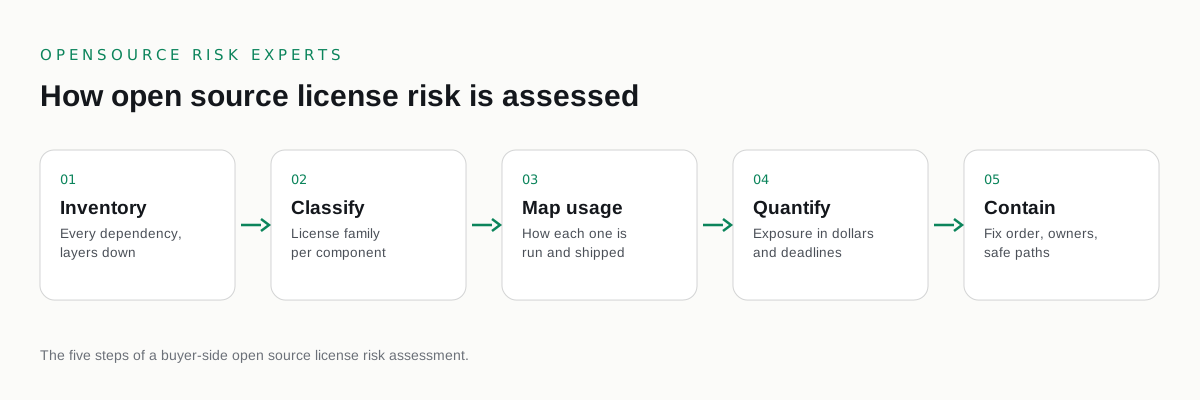
Every organization that runs open source carries some license risk. What sets regulated industries apart is the weight that attaches to it. A consumer software company that discovers a relicensed dependency can fix it on its own schedule. A regulated firm has to fix it, document the fix, and be ready to show an examiner that the control worked. The license change is identical. The consequences are not.
Why regulated firms are more exposed
Three features of regulated environments turn ordinary license risk into something heavier. The first is longevity. Core systems in finance, insurance, health, and critical infrastructure run for many years, sometimes decades. A dependency adopted under a permissive license can sit untouched inside a system of record long after the upstream project has changed terms. The exposure does not announce itself. It accumulates.
The second is documentation. Regulated firms must be able to evidence what they run and why. When a license changes, the obligation is not only to respond but to show a record of having responded. A firm that cannot say which version of a component it runs, under which license, and since when, has a control gap regardless of whether the underlying use is permitted. The third is supervision. An examiner can ask the question at any time, and the answer needs to already exist. There is no time to assemble it after the request.
The relicensing events that matter most
The recent wave hit exactly the tools that regulated firms depend on. HashiCorp moved Terraform, Vault, Consul, Nomad, and Packer to the Business Source License 1.1 as of August 2023, and these run at the center of infrastructure and secrets management in many supervised environments. Redis moved to a dual Redis Source Available License and Server Side Public License model as of March 2024, with the community fork Valkey now available. Elasticsearch and Kibana moved to the Server Side Public License and Elastic License in 2021, with the fork OpenSearch. MongoDB moved to the Server Side Public License in 2018. Source available is not the same as open source, and none of these are approved by the Open Source Initiative. A regulated firm that adopted any of these years ago under an open license may now be running them under terms it never reviewed.
The risk is rarely that internal use is suddenly prohibited. For most internal deployments these licenses still permit the use. The risk is the gap between what the firm believes it runs and what it can prove, and the possibility that an unusual deployment pattern, a hosted service, or an inherited system from an acquisition falls inside a restriction. Confirming your specific position is a matter for your own counsel, but you cannot ask the question until you have the map.
How the exposure shows up in an examination
Picture a supervisory review of third party and software risk. The examiner asks for the inventory of open source components in a critical system, their licenses, and the firm's process for detecting license changes. A firm with a current dependency map and a documented detection process answers in an afternoon. A firm without one faces an open ended finding and a remediation timeline imposed from outside. The difference is not the quality of the engineering. It is whether the evidence was maintained before the question arrived. This is why a software bill of materials and a continuous detection process matter as much for license risk as they do for security.
A practical response for regulated firms
Start with the map. Build a complete dependency tree for your critical systems, direct and transitive, and record the license state of each node. Treat that map as a controlled artifact, refreshed on a schedule, so it serves as evidence and not just a one time snapshot. Next, classify each use of a relicensed component against the relevant license, separating the clearly permitted from the genuinely uncertain, and bring the uncertain cases to your counsel. Then size and decide. For each material exposure, weigh the fork, pay, or remove options on cost, license posture, and timeline, and document the decision and its rationale. Finally, wire detection into intake so the next relicense is caught when a component enters the estate rather than during an examination. Done this way, license risk management becomes a control you can demonstrate rather than a fire you fight.
Where to read next
This article is part of our pillar on open source license risk. For sector adjacent reading, see open source license risk and AI model tooling and open source license risk in embedded software. For the underlying license families, see the pillar on HashiCorp and Terraform licensing and the broader pattern of relicensing exposure.
CONTAINMENT
Build the evidence before the examiner asks
An open source license risk assessment gives regulated firms a current, defensible map of what they run and under which terms. Independent, buyer side, paid only by you.
Not ready to talk? Read the free open source license risk guides first.
One email when a major project relicenses. No marketing, unsubscribe any time.
Start a risk assessmentCOMMON QUESTIONS
Questions buyers ask.
What is open source license risk for regulated industries?
Open source license risk for regulated industries is the exposure created when components in supervised systems change license terms. It matters more in regulated sectors because the same change must be reconciled with audit trails, evidence obligations, and supervisory expectations, not only with engineering and cost.
Why are regulated firms more exposed to relicensing?
Regulated firms run long lived systems, carry heavy documentation duties, and answer to supervisors. A relicensed dependency can sit untouched for years inside a system of record, so the exposure accumulates quietly and surfaces during an examination rather than a routine review.
Which relicensing events affect regulated industries most?
The widely used infrastructure and data tools matter most. HashiCorp moved to the Business Source License as of August 2023, Redis to the Server Side Public License as of March 2024, Elasticsearch and Kibana in 2021, and MongoDB to the Server Side Public License in 2018. These run in core systems across finance and other regulated sectors.
How should a regulated firm respond?
Start by mapping where relicensed components run and keeping that map current as evidence. Then classify use against each license, size the exposure, and choose a fork, pay, or remove path that you can document. The map itself becomes part of your supervisory record.
Is this legal advice?
No. This is commercial and licensing risk advisory, not legal advice. For interpretation of license terms and regulatory obligations, engage your own counsel and compliance function.
MORE IN THIS CLUSTER