ARTICLE . UPDATED JUNE 2026
Open Source License Risk Red Flags to Watch
BY MORTEN ANDERSEN · REVIEWED BY FREDRIK FILIPSSON
The open source license risk red flags to watch are the signals that a dependency may change terms before it does. None of them is a guarantee. Together they tell you which components sit on stable ground and which sit on a vendor decision that has not been made yet. Read them at adoption and you buy time. Read them after a vendor announcement and you are already reacting.
Every relicensing event of the last few years was preceded by signals that were visible in advance. The companies behind HashiCorp, Redis, Elastic, and MongoDB each carried the same structural features long before they changed terms. Single vendor control, a contributor agreement that allowed the change, and commercial pressure from cloud providers were all present and public. The buyers who were surprised were not short of information. They had simply never set up a watch list. This article is that watch list, organized so it can be applied to any dependency in your estate.
Red flag one: a single company controls the project
The first and most important open source license risk red flag is ownership. A project governed by a neutral foundation needs broad agreement across many parties to change its license, which makes a relicense slow and unlikely. A project owned and steered by one company can change terms when that company decides its commercial interest has shifted. Look at who holds the trademark, who employs the maintainers, and who merges the majority of commits. When all three point to one firm, the barrier to relicensing is low. This is the precondition that sat beneath every major change in the current wave.
Single vendor control is not a reason to avoid a component. Many of the most useful tools in production are vendor led. It is a reason to treat the license as something the vendor can move rather than a fixed property of the software. The practical response is to track the project, not to ban it.
Red flag two: a contributor license agreement that assigns broad rights
A contributor license agreement decides who has the legal power to relicense. When contributors assign broad rights to one company, that company can change the license of the entire codebase without returning to every past contributor for permission. When no such agreement exists, a relicense is far harder, because the rights are spread across everyone who ever committed code. The presence of a broad contributor agreement is therefore a structural signal, visible in the project repository, that the legal path to a relicense is already clear. It belongs on the watch list beside ownership, because the two together make a change both possible and easy.
Red flag three: commercial pressure and the cloud provider problem
Most relicensing events are driven by money. A vendor that builds an open project, then watches a large cloud provider sell a managed version of it, has a direct incentive to change the terms. This is the pattern behind the move of Elasticsearch and Kibana to the Server Side Public License and the Elastic License as of 2021, and behind Redis moving to a dual model with the Server Side Public License as of March 2024. The signal to watch is a public dispute between the vendor and a hyperscaler, or a vendor whose revenue depends heavily on a managed service that a cloud provider could undercut. When you see that tension, a license change is a rational next move for the vendor, and you should plan as if it is coming.
Funding and ownership changes sharpen this pressure. A new investor or an acquisition can reset a vendor's priorities toward monetization. HashiCorp moved Terraform, Vault, Consul, Nomad, and Packer to the Business Source License 1.1 as of August 2023, and was later acquired by IBM. The mechanics of an ownership driven change are covered in how a license change creates enterprise exposure.
Red flag four: the component sits deep and wide in your estate
The first three red flags are about the project. This one is about you. A relicense only hurts in proportion to how much of your estate depends on the component. A vendor controlled tool that touches one isolated service is a small problem even if it changes terms. The same tool beneath forty services is a program of work. The red flag here is concentration: a single dependency that many of your products rely on, often through the indirect part of the tree where it is easy to miss. The way to find that concentration is set out in transitive dependencies and hidden license risk, and the way to size it once found is covered in quantifying open source license exposure.
Turning the red flags into a watch list
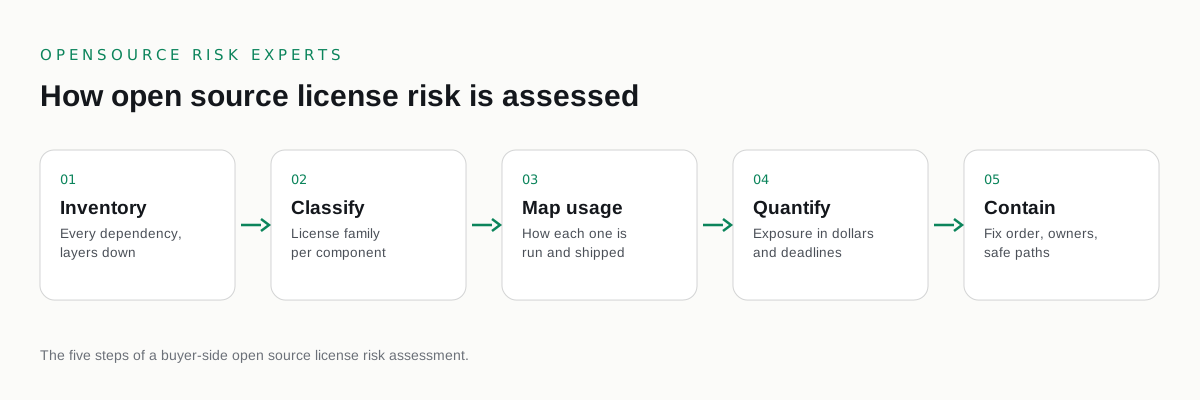
A watch list is only useful if it is applied consistently. The practical method is to resolve your dependency tree, direct and transitive, then score each significant component against these signals: who controls it, whether a broad contributor agreement exists, whether commercial or cloud pressure is building, and how widely it sits in your estate. Components that score high on several signals are the ones to monitor closely and to have a containment plan ready for. Source available licenses such as the Business Source License and the Server Side Public License are not approved by the Open Source Initiative, and source available is not open source, so a component already under those terms is past the watch list stage and into active exposure.
This work sits on the open source license risk pillar, and an open source license risk assessment produces the scored watch list as a deliverable. We are independent and buyer side. We take no vendor fees and resell no software, so the red flags we raise reflect your exposure and nothing else. This is commercial and licensing risk advisory, not legal advice. For interpretation of specific license terms and your compliance position, engage your own counsel.
COMMON QUESTIONS
Questions buyers ask.
What are the main open source license risk red flags to watch?
The clearest signals are a single company that owns the trademark and controls most commits, a contributor license agreement that lets that company change terms, a recent funding round or acquisition, public friction with cloud providers, and a project whose revenue depends on a managed service. Any one of these raises the chance of a future relicense, and several together make it likely.
Does single vendor control mean a project will relicense?
No, but it removes the main barrier. A project governed by a foundation needs broad agreement to change terms. A project owned by one company can change them when its commercial interest shifts. Single vendor control is the precondition for most relicensing events, so it belongs at the top of any watch list.
Why does a contributor license agreement matter for license risk?
A contributor license agreement that assigns broad rights to one company gives that company the legal ability to relicense the whole codebase. Without it, a vendor would need permission from every past contributor. With it, the decision sits with one party. The presence of such an agreement is a structural red flag worth tracking.
How early can these red flags be spotted?
Most can be spotted at adoption, before a component is ever in production. Governance, ownership, and the contributor agreement are public facts. Commercial pressure builds over months and is visible in funding news and public disputes. A buyer who checks these signals at intake has time to plan, rather than reacting to a vendor announcement.
Is this legal advice?
No. This is commercial and licensing risk advisory, not legal advice. For interpretation of license terms and compliance questions, we recommend you engage your own counsel.
CONTAINMENT
Know which dependencies to watch.
A confidential open source license risk assessment. Independent, buyer side, paid only by you.
Not ready to talk? Read the free open source license risk guides first.
One email when a major project relicenses. No marketing, unsubscribe any time.
MORE IN THIS CLUSTER