ARTICLE . UPDATED JUNE 2026
Open Source License Risk When You Redistribute Software
BY FREDRIK FILIPSSON · REVIEWED BY MORTEN ANDERSEN
Open source license risk when you redistribute software is different in kind from the risk of using it internally. The same component that sits quietly behind your firewall can carry obligations that activate the moment you ship a copy to a customer. Distribution is the trigger that wakes dormant terms. If you build products that leave your building, the license question is not whether you may use the code but what travels with it when you hand it over.
A great deal of open source obligation is conditional. The condition that matters most for many licenses is distribution, meaning the act of conveying a copy of the software to someone outside your organization. Use a component only inside your own walls and many of its terms never fire. Put the same component inside a product you ship, an appliance you sell, or a container image you publish, and the conditions activate. This is why two companies running the identical dependency can carry entirely different exposure. One uses it internally. The other redistributes it. The license treats them differently, and so should any honest assessment.
What redistribution means and why it matters
Redistribution, for license purposes, generally means conveying a copy of the software to a third party. Shipping an installed desktop application counts. Selling a hardware appliance with software baked in counts. Publishing a container image that bundles dependencies counts. Handing a build to a customer to run on their own infrastructure counts. The common thread is that a copy leaves your control and lands with someone else. Running the same software purely for your own internal operations usually does not meet that threshold, which is why internal use carries a lighter obligation set than shipping a product.
The line is not always obvious. A subsidiary, a contractor, or a joint venture can sit on either side of the organizational boundary depending on the arrangement. Bundling a dependency inside a larger work can change how its terms apply to the whole. These are exactly the questions where a buyer should map the facts carefully and take the interpretation to counsel, because the answer turns on specifics rather than on a general rule.
Copyleft obligations that activate on distribution
Copyleft licenses are the clearest case. The GNU GPL ties its central obligation to distribution: when you ship a copy of GPL covered software, you generally must offer the corresponding source code and pass the same license terms downstream. Used internally, that source obligation lies dormant. Shipped in a product, it activates. For a redistributor, a single GPL component buried in a build can therefore create an obligation to make source available that the company never planned for. The risk is not that the license is unusable. It is that the obligation was invisible until a copy went out the door.
The GNU AGPL goes further. It extends the source trigger from shipping a binary to making the software available over a network, which means offering a hosted service can create the same obligation as distributing a copy. For a company that thought hosting kept it clear of distribution terms, the AGPL closes that gap. The mechanics of how these obligations reach into a product are part of the hidden open source exposure in production.
Source available terms and the redistributor
The recent relicensing wave adds a second layer for anyone who ships software. As of August 2023, HashiCorp moved Terraform, Vault, Consul, Nomad, and Packer to the Business Source License 1.1, which restricts competitive production use and can limit how a product built on those components is offered. Redis moved to a dual model with the Server Side Public License as of March 2024, and Elasticsearch and Kibana moved to the Server Side Public License and the Elastic License as of 2021. MongoDB moved to the Server Side Public License in 2018. Source available is not open source, and neither the Business Source License nor the Server Side Public License is approved by the Open Source Initiative. For a redistributor, a relicensed dependency inside a shipped product can change what the company is permitted to do with it, which is why a shipped product carries higher stakes than internal use when one of these components is present.
How to find redistribution exposure before you ship
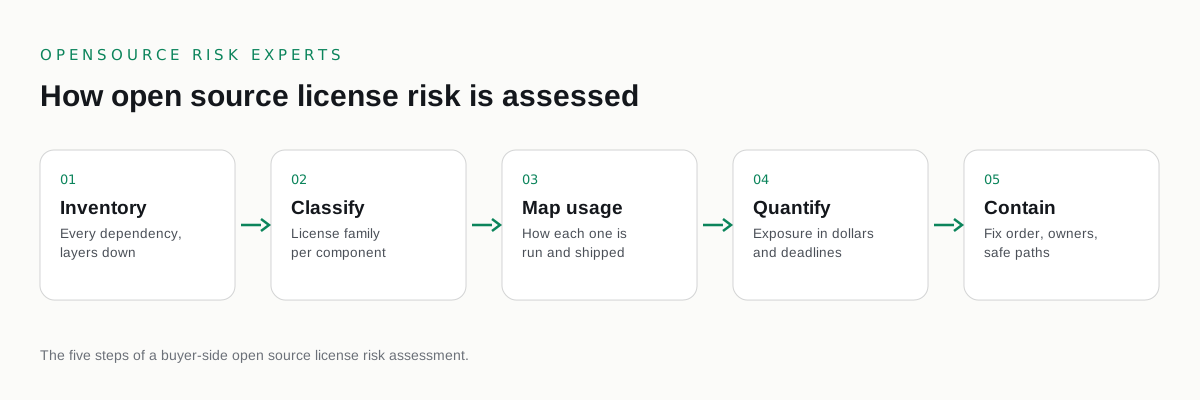
The method is the same discipline that governs all license risk, applied with the distribution trigger in mind. Resolve the full dependency tree of everything that goes into a shipped artifact, direct and transitive, and identify the components whose terms activate on distribution: copyleft licenses, the AGPL, and any source available component. Then decide for each whether the obligation can be met, the component replaced, or a license negotiated. Doing this before release is far cheaper than doing it after a customer holds a copy, because once shipped, a copy cannot be recalled and the obligation is already live. The way to build that tree is covered in transitive dependencies and hidden license risk.
This work sits on the open source license risk pillar, and an open source license risk assessment maps the redistribution exposure in a product before it ships. We are independent and buyer side. We take no vendor fees and resell no software, so our findings reflect your exposure and nothing else. This is commercial and licensing risk advisory, not legal advice. For interpretation of distribution terms and your compliance position, engage your own counsel.
COMMON QUESTIONS
Questions buyers ask.
Why does open source license risk rise when you redistribute software?
Many open source obligations only activate on distribution. Copyleft licenses such as the GNU GPL require you to offer source code when you ship a copy to a third party, and attribution terms require notices to travel with the binary. A component you use only internally may carry dormant obligations that wake up the moment you put it in a product you hand to someone else.
What counts as redistribution for license purposes?
Redistribution generally means conveying a copy of the software to a party outside your organization. Shipping an installed application, an appliance, a container image, or an embedded device usually counts. Running software internally or offering it as a hosted service may not be classic distribution, though the Server Side Public License and the GNU AGPL were written to reach service use as well.
How is the AGPL different from the GPL for redistributors?
The GNU GPL ties its source obligation to distributing a copy. The GNU AGPL extends that trigger to making the software available over a network, so offering a hosted service can create the same source obligation as shipping a binary. For a redistributor or a service provider, the AGPL closes the gap that hosting once left open.
Do source available licenses affect redistribution?
Yes. The Business Source License restricts competitive production use and can limit how you ship a product built on the component. The Server Side Public License attaches heavy conditions to offering the software as a service. Neither is OSI approved, and both can change what a redistributor is permitted to do, so a relicensed dependency in a shipped product deserves close review.
Is this legal advice?
No. This is commercial and licensing risk advisory, not legal advice. For interpretation of license terms and compliance questions, we recommend you engage your own counsel.
CONTAINMENT
Know what ships before it leaves the building.
A confidential open source license risk assessment. Independent, buyer side, paid only by you.
Not ready to talk? Read the free open source license risk guides first.
One email when a major project relicenses. No marketing, unsubscribe any time.
MORE IN THIS CLUSTER