ARTICLE / DATABASES
Database relicensing and your cloud provider.
BY MORTEN ANDERSEN · REVIEWED BY FREDRIK FILIPSSON
Database relicensing and your cloud provider are more entangled than most buyers expect. When Redis or Elasticsearch changes terms, the provider running your managed instance has to react, and that reaction reshapes your exposure. This guide explains how the change reaches you through your provider and what to confirm in your contract.
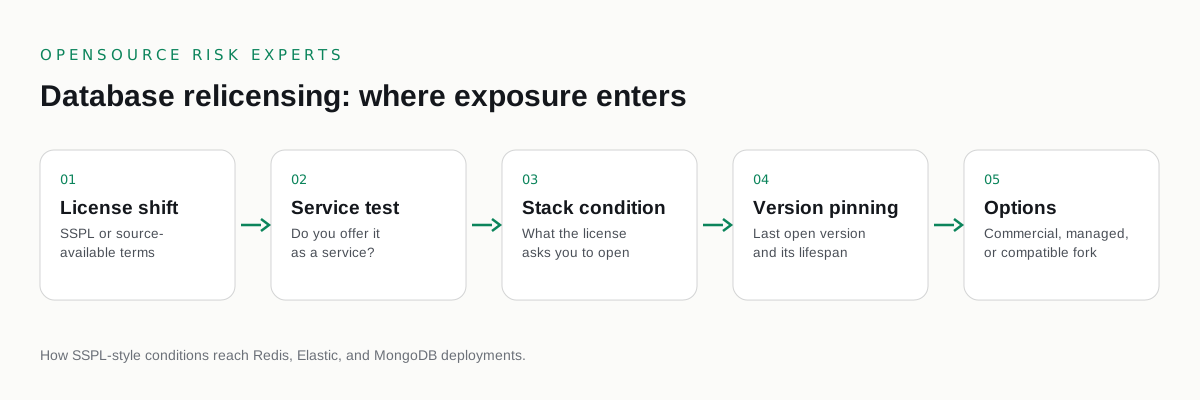
When a database relicenses, the first instinct is to look at your own code. That is correct but incomplete. A large share of database use runs through a cloud provider as a managed service, and database relicensing and your cloud provider relationship interact in ways that can change your exposure without a single line of your code being touched. The provider sits between you and the license, and what it decides to do becomes part of your risk picture.
Why a relicense reaches your provider first
The source available licenses adopted in the recent wave were aimed squarely at cloud providers. As of March 2024, Redis moved to the Redis Source Available License and the Server Side Public License. In 2021, Elasticsearch and Kibana moved to the Server Side Public License and the Elastic License. The stated target of these terms was the practice of offering the software as a managed service without contributing back. Your provider was the intended audience of the change, which is why the provider reacts before you even notice. Source available is not open source, and neither the Server Side Public License nor these source available terms are approved by the Open Source Initiative.
The paths a provider can take
A provider faced with a relicensed database has a few options, and each one lands differently on you. It can take a commercial license from the vendor and keep offering the original software, which usually shows up as changed service terms or pricing. It can fork the last open version and run that instead, which is how OpenSearch came from Elasticsearch and how Valkey came from Redis. It can rename and rebrand its managed offering around the fork. Or it can deprecate the service and ask customers to move. The path your provider chose determines what you must do, and it is the first fact to establish.
Why cloud providers led the forks
The major forks did not appear by accident. Cloud providers had built large managed businesses on Elasticsearch and Redis under their former open source licenses. When the terms moved to restrict exactly that business, the providers led forks to preserve an open license version they could continue to offer. Amazon Web Services led OpenSearch from Elasticsearch, and the Valkey project carried Redis forward under an open license with broad provider backing. For a buyer, a provider backed fork is significant because it means the operational work of running the open alternative has already been done at scale. The fork stories are worth understanding, and we cover them in the OpenTofu and Valkey fork story.
What your provider contract actually says
A managed service contract decides where the obligations sit, and the answer is often less protective than buyers assume. Many agreements place compliance responsibility on the customer for how the software is used, even when the provider operates it. Some include the right for the provider to change the underlying software or its terms with notice. Read your agreement for three things: who is responsible if the underlying license changes, whether the provider commits to a specific software version or reserves the right to substitute, and what indemnity, if any, covers a license dispute. These clauses turn an abstract relicense into a concrete allocation of risk between you and your provider.
Should you move to the provider's fork?
For many buyers, moving to the provider managed fork is the least disruptive answer. The provider has done the operational engineering, the migration is often a service change rather than a rebuild, and the result returns you to an open license footing. The caution is the same one that applies to any fork: confirm compatibility against your real workloads rather than assuming parity, and read the new service terms so you understand what you are agreeing to. Where the fork is not a clean fit, a full migration may be warranted, which we cover in migrating from Elasticsearch to OpenSearch.
Bringing the picture together
The full exposure from a database relicense is the sum of what runs in your own code and what runs through your provider. Map both. Establish which path your provider took, read what your contract commits each side to, and confirm whether a managed fork resolves the question or simply defers it. The obligations that flow from the license itself are covered in our guide to database relicensing compliance obligations. Interpretation of your provider agreement is a question for your own counsel.
Untangling provider exposure is part of our open source remediation advisory service. For the wider frame, read our pillar on Redis, Elastic, and database relicensing.
COMMON QUESTIONS
Questions buyers ask.
Does a database relicense affect my managed cloud service?
It can. When a database such as Redis or Elasticsearch relicenses, your cloud provider must decide whether to follow the new terms, offer a fork, or rename its service. Your exposure depends on which path your provider took and what its contract now commits to, so the relicense is felt through your provider as much as through your own code.
Who carries the license risk in a managed database service?
In a managed service the provider operates the software, but the contract decides where the obligations and indemnities sit. Many agreements shift compliance responsibility back to the customer in some form. Read the terms and confirm who is responsible if the underlying license changes again.
Why did cloud providers create forks like OpenSearch and Valkey?
Cloud providers offered managed services on Elasticsearch and Redis under their former open source licenses. When those projects moved to source available terms that targeted exactly that use, providers led forks. OpenSearch came from Elasticsearch and Valkey came from Redis, both under open licenses.
Should I move to my provider's forked database service?
Often it is the least disruptive path, because the provider has already done the operational work. Confirm compatibility against your workloads and read the new service terms. A managed fork can remove the source available question while keeping your operational model intact.
Is this legal advice about my cloud contract?
No. This is commercial and licensing risk advisory, not legal advice. For interpretation of your provider agreement and the underlying license terms, we recommend your own counsel.
REMEDIATION
Map your provider exposure with us.
Our remediation advisory traces the relicense through your provider and your own code. Independent, buyer side, paid only by you.
Not ready to talk? Read the free open source license risk guides first.
One email when a major project relicenses. No marketing, unsubscribe any time.
MORE IN THIS CLUSTER