ARTICLE . UPDATED JUNE 2026
The Real Cost of Staying on HashiCorp BSL
BY MORTEN ANDERSEN · REVIEWED BY FREDRIK FILIPSSON
The real cost of staying on HashiCorp BSL is rarely the line on an invoice. Staying put on the Business Source License version of Terraform or Vault carries a quieter set of costs: the overhead of proving your use stays inside the permitted lines, the lock in of deepening reliance on a restricted tool, and the leverage you lose when you reach a renewal with no credible alternative. None of these arrives as a bill, which is exactly why they are easy to miss.
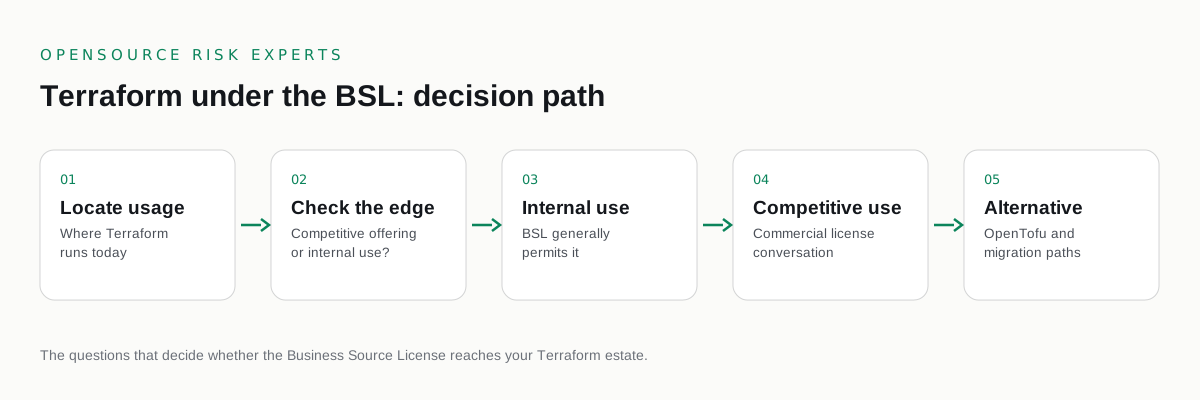
When HashiCorp moved Terraform, Vault, Consul, Nomad, and Packer to the Business Source License 1.1 as of August 2023, many teams made a reasonable near term choice: keep using the tools and see what happens. For some that was the right call. But staying is a decision with costs, and treating it as the absence of a decision hides them. The Business Source License restricts competitive production use and converts to an open license after a delay, commonly four years. Within that window, a buyer who stays is carrying obligations and risks that deserve to be named and priced, the same way the cost of moving would be.
The compliance overhead of staying inside the line
The Business Source License permits many production uses while restricting competitive use specifically. That sounds reassuring until you have to prove, on an ongoing basis, that everything you do with the tool stays on the permitted side of the line. As your use of Terraform spreads across teams and products, the question of whether any of it has drifted toward competitive use becomes a recurring review rather than a one time answer. That review has a cost in time and attention, and getting it wrong has a larger one. Whether a given use is competitive is fact specific and a question for your own counsel, as set out in is your Terraform use competitive under the BSL. The compliance obligations that come with staying are detailed in HashiCorp BSL compliance obligations.
The lock in cost of deepening reliance
Every quarter you stay, your estate tends to lean a little harder on the tool. More modules, more pipelines, more teams build on it, and the eventual cost of leaving rises with that reach. This is the same dynamic that makes any relicensed component more expensive to unwind over time, applied to Terraform specifically. The component does not change. Your blast radius does. A footprint that would have been cheap to migrate at the moment of the license change can become a multi quarter program a year later, simply because normal delivery kept building on it. Understanding that reach is the subject of assessing Terraform exposure across teams, and it is the single largest hidden cost of staying.
The leverage you lose at renewal
Negotiation leverage comes from having a credible alternative. The more deeply you rely on the Business Source License version of Terraform with no migration path prepared, the less believable your option to leave becomes, and the more the vendor's list price sets the terms of your renewal. Staying, done passively, quietly transfers pricing power to the supplier. The antidote is not necessarily to leave but to keep a real alternative live: OpenTofu, the community fork under a neutral foundation, continues the last open version under an open license and remains a genuine path. Source available is not open source, and the Business Source License is not approved by the Open Source Initiative, so the open fork is a meaningfully different posture, not just a different vendor. Keeping that option credible is itself a cost of staying, and a benefit you pay for by not letting the migration path atrophy.
Comparing the cost of staying with the cost of moving
None of this means leaving is automatically right. For a small, isolated Terraform footprint, a move to OpenTofu can be inexpensive and remove the restriction entirely. For a deep, multi team estate, migration is a real program, and staying may be the cheaper choice in the near term while a longer plan is built. The point is to make the comparison honestly, pricing the quiet costs of staying against the visible costs of moving on the same basis. That comparison is the work, and it is what turns staying from a default into a decision. This sits on the HashiCorp and Terraform pillar, and a relicensing exposure review produces it.
We are independent and buyer side. We take no vendor fees and resell no software, so the cost of staying we produce reflects your exposure and nothing else, including when the honest answer is that staying for now is the cheapest defensible path. This is commercial and licensing risk advisory, not legal advice. For interpretation of the Business Source License and whether your use is competitive, engage your own counsel.
COMMON QUESTIONS
Questions buyers ask.
What is the real cost of staying on HashiCorp BSL?
It is more than the license fee. Staying on the Business Source License version of Terraform or Vault carries an ongoing compliance overhead to prove your use is not competitive, the lock in that comes from deepening reliance on a restricted component, and the lost leverage of having no credible alternative at renewal. These costs are real even when no invoice names them.
Does staying on the BSL mean you have to pay HashiCorp?
Not necessarily. The Business Source License permits many production uses without a commercial license, restricting competitive use specifically. Whether your use is competitive is a fact specific question for your own counsel. The cost of staying is often not a forced fee but the overhead of monitoring that line and the weaker position you hold if the vendor raises prices.
Is staying on the BSL cheaper than moving to OpenTofu?
It depends on your blast radius. For a small, isolated Terraform footprint, a move to OpenTofu can be inexpensive and remove the restriction entirely. For a deep, multi team estate, migration is a real program, and staying may be cheaper in the near term while you plan. The honest comparison prices both paths on the same basis rather than assuming either is free.
Why does staying on the BSL erode negotiation leverage?
Leverage at renewal comes from having a credible alternative. The longer you deepen reliance on a Business Source License component with no migration path prepared, the less believable your option to leave becomes, and the more the vendor's list price sets the terms. Keeping OpenTofu or another path live is itself a cost of not staying, and a benefit.
Is this legal advice?
No. This is commercial and licensing risk advisory, not legal advice. For interpretation of the Business Source License and whether your use is competitive, we recommend you engage your own counsel.
CONTAINMENT
Price staying before you default into it.
A confidential relicensing exposure review. Independent, buyer side, paid only by you.
Not ready to talk? Read the free open source license risk guides first.
One email when a major project relicenses. No marketing, unsubscribe any time.
MORE IN THIS CLUSTER