ARTICLE / HASHICORP AND TERRAFORM
Terraform exposure in a multicloud estate.
BY MORTEN ANDERSEN · REVIEWED BY FREDRIK FILIPSSON
Terraform sits at the center of provisioning, so Terraform exposure in a multicloud estate reaches further than almost any other relicensed component. This guide explains how the Business Source License change spreads across clouds, teams, and pipelines, and how to map and contain it before anyone audits it.
Most relicensed components live in one corner of a stack. Terraform is different. It is the tool that stands up the stack itself, often across every cloud a company uses. That central position is exactly why its license change matters more in a complex estate. When the tool that provisions everything moves to a restricted license, the change does not touch one product. It touches the way the whole organization builds. Understanding the breadth is the first step to sizing it honestly.
What Terraform exposure in a multicloud estate looks like
As of August 2023, HashiCorp moved Terraform to the Business Source License 1.1, along with Vault, Consul, Nomad, and Packer. In a single cloud, single team setup, mapping the impact is simple. In a multicloud estate it is not, because Terraform runs in many places at once: developer laptops, dozens of CI pipelines, and provisioning services across each cloud provider. Each of those is a place the Terraform binary executes, and each carries whatever license its version holds. The exposure is wide not because Terraform is uniquely risky but because it is uniquely pervasive. One license change lands everywhere the binary runs, which in a large estate is almost everywhere.
The binary, the providers, and the modules
It helps to separate the layers. The Business Source License attaches to the Terraform binary that HashiCorp relicensed. Providers, the plugins that talk to each cloud, and modules, the reusable configurations teams share, carry their own licenses set by their authors, which vary widely. So the binary is the consistent center of the exposure, while providers and modules need their own review and may be openly licensed, restrictively licensed, or somewhere in between. In practice the main question for most enterprises is the binary and whether the overall use competes with HashiCorp, but a complete map records the license of the providers and modules too, because that is where surprises occasionally hide.
Where the competitive use question gets sharper
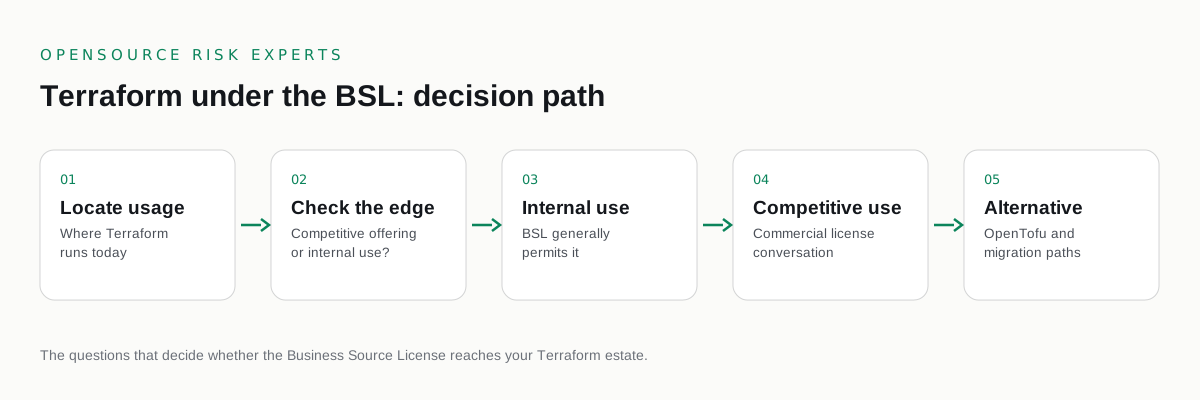
For most multicloud users, Terraform provisions their own infrastructure, which sits inside the additional use grant. The question sharpens when Terraform is embedded in something offered to customers, for example an internal developer platform that is also sold as a product, or a managed provisioning service. In a large estate, those product surfaces are easy to lose track of, because the team that built the platform may not be the team that decided to sell it. The competitive use line therefore needs checking wherever Terraform crosses from internal tooling into a paid offering. Whether a given use sits inside or outside the grant is a question for your own counsel, but you cannot ask the question until you have found the use.
CI pipelines and the version drift problem
In a multicloud estate, the Terraform version is rarely uniform. Different teams pin different versions, CI images update on their own schedules, and some pipelines run whatever the base image ships. Because the Business Source License applies to releases from the August 2023 boundary, this version drift means some pipelines may run pre change releases under the old license while others run BSL releases. The estate can be partly on one side of the line and partly on the other, often without anyone tracking which. Pinning a consistent, known version across pipelines is both an operational improvement and a licensing control, because it makes your position knowable.
Mapping and containing the exposure
Containment starts with a complete inventory of where the Terraform binary runs across every cloud, every CI system, and every provisioning service, with the version each uses. Mark each location against the August 2023 boundary and flag any use that forms part of a paid offering. From there the options are the familiar ones, applied estate wide: migrate to OpenTofu, the openly licensed fork that aims for compatibility, stay on pre change releases where that is acceptable, remove or re architect the few uses that edge toward competitive, or negotiate a commercial license sized to your real usage. In a multicloud estate the migration path usually favors OpenTofu for its breadth, but the compatibility should be validated against your providers, modules, and pipelines rather than assumed. The map makes that decision concrete instead of theoretical.
From a sprawling estate to a contained position
Sizing Terraform exposure across clouds is part of our relicensing exposure review. For the full picture, read our pillar on the HashiCorp and Terraform license change. To extend the view across the suite, read Consul, Nomad and Packer under the BSL, and for the duties that follow, read HashiCorp BSL compliance obligations. For the license mechanics, read the Business Source License explained.
COMMON QUESTIONS
Questions buyers ask.
What is Terraform exposure in a multicloud estate?
It is the set of risks created when Terraform under the Business Source License runs across multiple clouds and teams. The exposure is wide because Terraform sits at the center of provisioning, so the BSL change touches every cloud, module, and pipeline that depends on the Terraform binary. The breadth is the point: a single license change reaches the whole estate at once.
Does the BSL apply to Terraform providers and modules?
The Business Source License attaches to the Terraform binary that HashiCorp moved in August 2023. Providers and modules have their own licenses, which vary by author, so they need separate review. The practical exposure usually centers on the Terraform binary itself and on whether your overall use competes with HashiCorp, but the provider and module licenses still belong in the map.
Is OpenTofu a drop in replacement across clouds?
OpenTofu is the openly licensed community fork of Terraform and aims for compatibility, which makes it a strong candidate in a multicloud estate. Compatibility is close but should be validated against your providers, modules, and CI before a full migration. Treat it as a tested migration, not an automatic swap.
How do we map Terraform exposure across many teams?
Inventory every place the Terraform binary runs: developer machines, CI runners, and provisioning services across each cloud. Record the version each uses against the August 2023 boundary, and classify whether any use forms part of an offering you sell. A current inventory turns a sprawling estate into a list you can act on.
Is this legal advice?
No. This is commercial and licensing risk advisory, not legal advice. For interpretation of whether your multicloud Terraform use falls inside the additional use grant, we recommend your own counsel.
RELICENSING EXPOSURE
Map Terraform across every cloud you run.
Our relicensing exposure review traces Terraform across clouds, pipelines, and product surfaces. Independent, buyer side, paid only by you.
Not ready to talk? Read the free open source license risk guides first.
One email when a major project relicenses. No marketing, unsubscribe any time.
MORE IN THIS CLUSTER