ARTICLE . UPDATED JUNE 2026
Commercial Licensing for Redis Enterprise
BY MORTEN ANDERSEN · REVIEWED BY FREDRIK FILIPSSON
Commercial licensing for Redis Enterprise became a live question for many buyers after the 2024 license change. A commercial license is one of several paths, not the only one, and it is the right path for a specific set of cases rather than for everyone running Redis. The starting point is to understand what changed, what the source available terms now cover, and where a commercial license actually applies, so the decision is made on the facts of your own use rather than on a vendor's opening position.
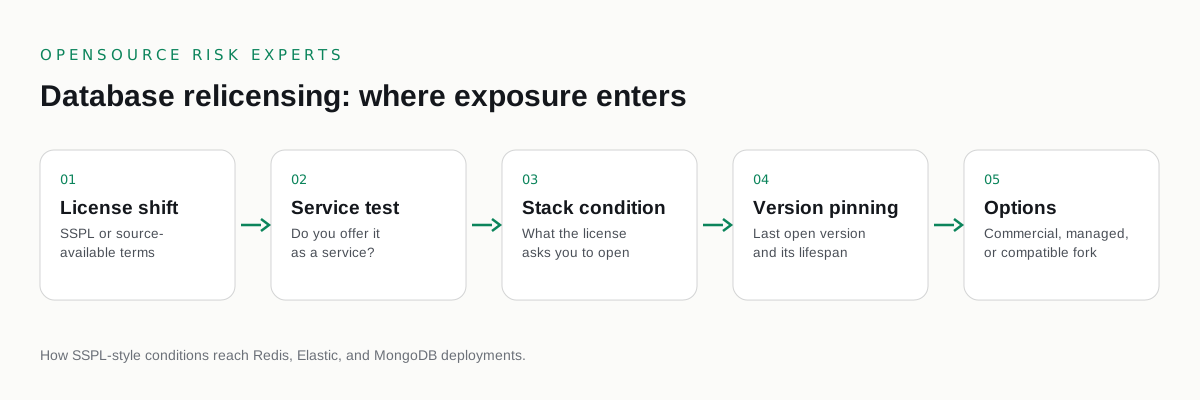
Redis is one of the most widely deployed pieces of infrastructure in modern software. It sits behind caches, queues, session stores, and rate limiters across estates of every size, often as a quiet dependency that no one revisits. When the license changed, that ubiquity is exactly what made the question urgent. A component this common, suddenly under new terms, raises the same question everywhere at once: do we now need to pay, and if so, for what.
What the Redis license change actually did
As of March 2024, Redis moved from an open source license to a dual model under the Redis Source Available License version 2 and the Server Side Public License. Redis later added an open license option as well. The community fork that preserves a fully open licensed path is Valkey, which is maintained under a foundation and tracks the prior open behavior. Source available is not the same as open source, and neither the Redis Source Available License nor the Server Side Public License is approved by the Open Source Initiative. These are accuracy anchors, dated as of June 2026, in an area that continues to move.
The source available licenses permit broad use and then restrict one thing in particular: offering the functionality of Redis to third parties as a managed service. That restriction targets the cloud and hosting providers that built businesses on Redis without a commercial relationship. For most enterprises, which run Redis to support their own applications, the source available terms or the open option already cover the use. The broader pattern of the change sits on the Redis, Elastic and databases pillar.
When a commercial license actually applies
A commercial license for Redis Enterprise becomes relevant in a narrower set of cases than the alarm around the change suggested. The clearest is the managed service case: if you offer Redis itself as a service to third parties, the source available conditions reach you, and a commercial license is one way to resolve that. The next is the support case: an organization may want the additional capabilities, hardening, and vendor backing of the Enterprise product regardless of license obligation, and a commercial agreement delivers that. The third is the comfort case, where legal or procurement prefers the certainty of a paid agreement over reasoning about source available conditions.
What does not, by itself, require a commercial license is ordinary internal use. Running Redis as a cache or a queue for your own applications is the common case the source available terms are designed to permit, and it is also the case the Valkey fork serves under a fully open license. The mistake is to treat a vendor outreach as proof that payment is owed. Whether a commercial license applies to you is a question for your own counsel against your specific use, and it deserves an answer grounded in evidence rather than pressure. The parallel reasoning for the original database relicense is set out in MongoDB SSPL the original relicense explained.
How to size Redis Enterprise exposure before you negotiate
The work that grounds any commercial conversation is an inventory. You map where Redis runs across the estate, record the version and license each instance carries, and identify whether any use offers Redis as a service to third parties. That picture answers the threshold question, whether you are even in the territory a commercial license addresses, before any number is discussed. It also separates the instances that are plainly internal and covered from the few, if any, that touch the restricted conditions.
A vendor pricing proposal is usually built from total deployment, applied at a list rate. A dated inventory lets you reframe that. It shows which instances run pre change versions still under the prior open license, which could move to Valkey at modest cost, and which genuinely warrant a commercial agreement. The agreement that results then reflects your actual usage and leverage rather than a list price built for a different customer. Where a commercial license is the answer, structuring it from the buyer side is the work of an open source commercial license negotiation engagement.
Weighing the commercial license against the alternatives
A commercial license is rarely the only option, and treating it as such forfeits leverage. The realistic alternatives sit alongside it: staying on the source available terms where your use is covered, moving to the Valkey fork to keep a fully open license, or in some cases continuing on pre change versions for components that do not need newer features. Each option carries an engineering cost and a license posture, and the right choice depends on how much migration effort you can absorb against how much certainty you want. That trade is the subject of forking versus paying the database decision.
The point of holding all the options open is leverage. A buyer who can credibly move to Valkey negotiates a commercial license on better terms than one who has already decided to pay. The evidence that makes that credibility real is the inventory, which is why the mapping comes before the negotiation rather than after. We are independent and buyer side. We take no vendor fees and resell no software, so the recommendation reflects your risk and nothing else. This is commercial and licensing risk advisory, not legal advice. For interpretation of the Redis licenses against your use, engage your own counsel.
COMMON QUESTIONS
Questions buyers ask.
When does commercial licensing for Redis Enterprise apply?
A commercial license becomes relevant when your use of Redis falls outside the conditions of the source available licenses Redis now uses, most often when you offer Redis as a managed service to third parties. Ordinary internal use of Redis is usually covered by the source available terms or by the open license option. Whether a commercial license applies to you is a question for your own counsel against your specific use.
What changed with the Redis license in 2024?
As of March 2024, Redis moved from an open source license to a dual model under the Redis Source Available License version 2 and the Server Side Public License. Redis later added an open license option as well. The community fork that preserves an open licensed path is Valkey. Source available is not open source, and these source available licenses are not approved by the Open Source Initiative.
Do we have to pay for Redis after the license change?
Not necessarily. Many enterprises continue under the source available terms or move to the open licensed Valkey fork without a commercial license. A commercial license is one option, suited to organizations that want vendor support or whose use touches the conditions the source available licenses restrict. The right answer depends on how you use Redis.
How do we size Redis Enterprise commercial exposure?
Map where Redis runs, which version and license each instance carries, and whether any use offers Redis as a service to third parties. That picture shows whether the source available terms cover you, whether Valkey is a fit, or whether a commercial license is warranted, and it is the evidence that grounds any pricing conversation.
Is this legal advice?
No. This is commercial and licensing risk advisory, not legal advice. For interpretation of license terms and compliance questions, we recommend you engage your own counsel.
CONTAINMENT
Decide on the facts, not the opening price.
A confidential open source remediation advisory. Independent, buyer side, paid only by you.
Not ready to talk? Read the free open source license risk guides first.
One email when a major project relicenses. No marketing, unsubscribe any time.
MORE IN THIS CLUSTER