REDIS, ELASTIC AND DATABASES
Elasticsearch vs OpenSearch: the migration decision.
BY FREDRIK FILIPSSON · REVIEWED BY MORTEN ANDERSEN
The Elasticsearch to OpenSearch migration decision is rarely as simple as the license name suggests. This is how to weigh license posture, compatibility, and engineering cost so the path you pick holds under scrutiny.
Commercial and licensing risk advisory, not legal advice.
The Elasticsearch to OpenSearch migration decision became live for many enterprises after the Elastic license change of 2021 moved Elasticsearch and Kibana to source available terms. OpenSearch is the AWS led fork that continues the function under the Apache 2.0 open source license. On the surface the choice looks binary: stay on source available terms or move to an open source fork. In practice it is a weighing exercise across license posture, compatibility, engineering cost, and the maturity of each project, and the right answer differs by deployment. This article frames that decision the way a buyer side advisor would.
It sits within the wider cluster on Redis, Elastic and database relicensing, and assumes you have already read what the change did, covered in the Elastic license change explained.
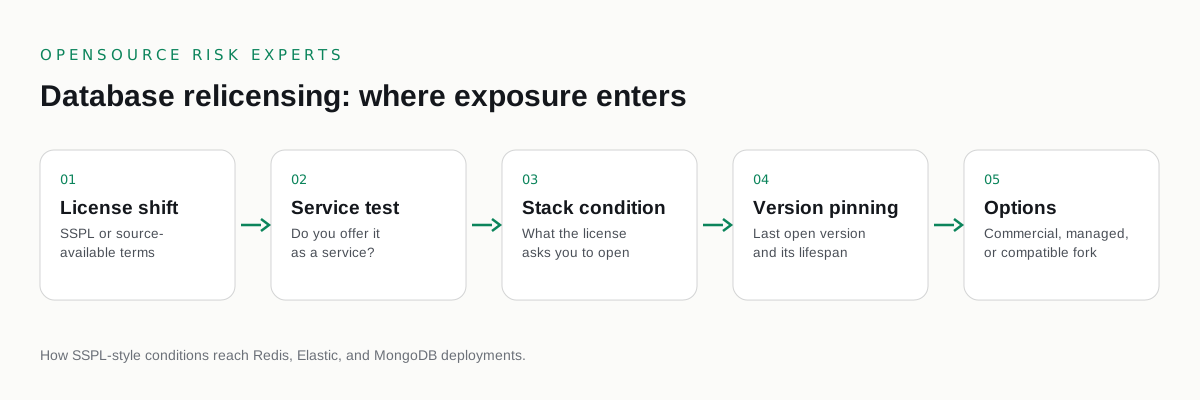
Start with whether you have a problem at all
Before weighing the migration, confirm that the Elastic license change actually reaches your use. The central restrictions of the Server Side Public License and the Elastic License are aimed at offering the software to third parties as a service. A company that runs Elasticsearch internally to power its own search and analytics usually sits comfortably inside the Elastic License and faces no forced choice. The exposure concentrates in companies that host or resell the function. If your use is purely internal, the migration decision may be one of preference and future proofing rather than necessity, and that changes how much engineering cost is worth spending. The first step is the question posed in is your Elasticsearch use affected.
The license posture each path gives you
OpenSearch is licensed under Apache 2.0, a permissive open source license approved by the Open Source Initiative. Moving to it restores the open source footing that Elasticsearch had before 2021 and removes the managed service and feature gating restrictions that the source available terms introduced. Staying on Elasticsearch leaves you on the Elastic License or the Server Side Public License, unless you adopt the GNU AGPL option that Elastic added as of 2024. The AGPL is genuine open source, but it is strong copyleft with a network clause, so it is not a clean equivalent to Apache 2.0. The cleanest license posture is OpenSearch, the most familiar one is the Elastic License, and the AGPL sits between them with obligations of its own.
Compatibility and the cost of moving
OpenSearch began as a fork of Elasticsearch 7.10, the last Apache 2.0 release, so older deployments often migrate with limited friction. The two projects have diverged since, which means newer Elasticsearch features, client libraries, and APIs may have no exact OpenSearch equivalent. The migration cost is driven by how far your deployment has moved past the fork point and how deeply your applications are coupled to Elasticsearch specific behavior. Index mappings, query syntax, ingest pipelines, and client versions all need checking. A migration that looks trivial at the cluster level can carry real work at the application layer, which is why a compatibility assessment precedes any commitment. The mechanics are set out in migrating from Elasticsearch to OpenSearch.
When staying on Elasticsearch is the right call
Migration is not always the answer. If your use is internal and sits inside the Elastic License, if you depend on Elasticsearch features that OpenSearch does not match, or if the AGPL option gives you an acceptable open source path, staying can be the lower risk choice. A forced migration that breaks search relevance or ingestion can cost more than the license concern it was meant to solve. The discipline is to let actual use and real migration cost drive the decision rather than a reflex against source available terms. This is the same calculus that applies across the relicensing wave, framed in forking versus paying, the database decision.
How to make the decision defensible
A defensible Elasticsearch to OpenSearch migration decision rests on three inputs: a clear read of how each instance is used, a compatibility assessment against the specific version and features you run, and an honest estimate of migration cost and elapsed time. Set those against the value of a cleaner license posture, and the right path usually becomes obvious. Document the reasoning, because the same record answers a board question, a procurement review, or a future audit. The decision is not permanent either, since OpenSearch and Elasticsearch continue to evolve, so revisit it when your version or your use materially changes.
This article is commercial and licensing risk advisory, not legal advice. For interpretation of the Elastic License, the Server Side Public License, the AGPL, or the OpenSearch license against your specific deployment, your own counsel is the right place to turn.
COMMON QUESTIONS
Questions buyers ask.
What is the Elasticsearch to OpenSearch migration decision?
The Elasticsearch to OpenSearch migration decision is the choice between staying on Elasticsearch under the Elastic License, the Server Side Public License, or the newer GNU AGPL option, and moving to the AWS led fork OpenSearch under the Apache 2.0 open source license. It weighs license posture against compatibility, engineering cost, and the maturity of each project.
Is OpenSearch a drop in replacement for Elasticsearch?
OpenSearch began as a fork of Elasticsearch 7.10, the last Apache 2.0 release, so older deployments often migrate with limited friction. The two projects have diverged since, so newer Elasticsearch features, clients, and APIs may have no exact OpenSearch equivalent. Compatibility should be confirmed for the specific version and features in use rather than assumed.
When should an enterprise stay on Elasticsearch?
Staying on Elasticsearch can be the right call when internal use sits comfortably within the Elastic License, when you depend on features that have no OpenSearch equivalent, or when the AGPL option introduced as of 2024 gives you an acceptable open source path. The decision turns on how you use the software and the cost of a migration, not on the license name alone.
Does moving to OpenSearch remove the license risk?
Moving to OpenSearch replaces source available Elasticsearch terms with the Apache 2.0 open source license, which removes the managed service and feature gating restrictions that prompted the concern. It introduces a migration project and a dependency on a fork whose roadmap can diverge, so the decision weighs a cleaner license posture against engineering effort.
Is this migration advice legal advice?
No. This is commercial and licensing risk advisory, not legal advice. For interpretation of the Elastic License, the Server Side Public License, the AGPL, or the OpenSearch license against your use, engage your own counsel.
CONTAIN THE EXPOSURE
Weigh the migration before you commit to it.
A confidential open source license risk assessment. Independent, buyer side, paid only by you.
Not ready to talk? Read the free open source license risk guides first.
One email when a major project relicenses. No marketing, unsubscribe any time.
MORE IN THIS CLUSTER