ARTICLE / HASHICORP AND TERRAFORM
Consul, Nomad and Packer under the BSL.
BY MORTEN ANDERSEN · REVIEWED BY FREDRIK FILIPSSON
Terraform took the headlines, but Consul, Nomad and Packer under the BSL carry their own exposure, often in the parts of your stack that touch a product you sell. This guide explains what changed for each tool, where the risk concentrates, and the fork and migration options worth weighing.
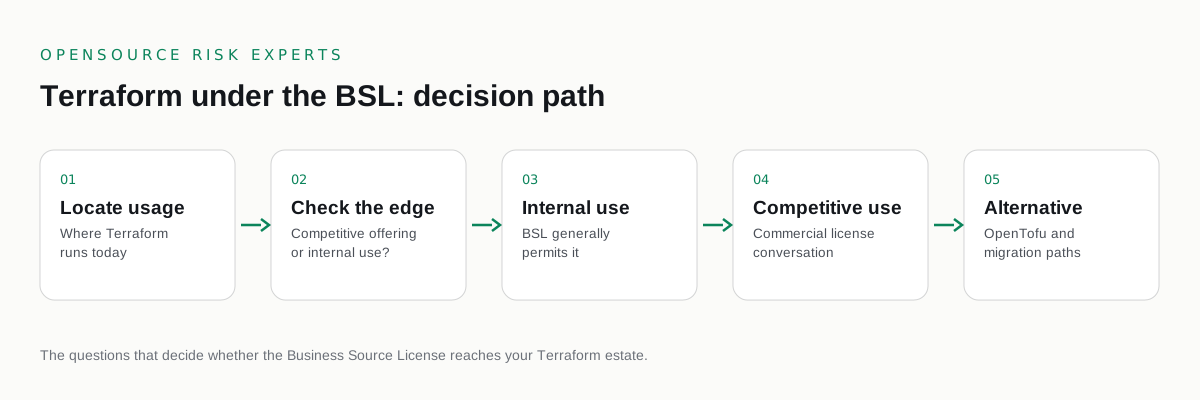
When the HashiCorp license change is discussed, the conversation usually centers on Terraform and its fork, OpenTofu. That focus leaves a gap. Consul, Nomad, and Packer moved at the same time, sit deep in many production platforms, and often live closer to a revenue generating product than Terraform does. The teams that mapped only Terraform have a blind spot, and closing it starts with understanding what each tool does and where its use can cross a line.
What changed for Consul, Nomad and Packer under the BSL
As of August 2023, HashiCorp moved Consul, Nomad, Packer, Terraform, and Vault from an open source license to the Business Source License 1.1. Releases published from that point carry the BSL, which permits reading, copying, and modifying the code but restricts a defined production use, broadly the offering of a competing product or service. Releases published before the change keep their original open license. So the same tool can carry different terms depending on the version you run, and the obligation to know your version applies here exactly as it does across the rest of the HashiCorp suite. The Business Source License is source available, not open source, and is not approved by the Open Source Initiative.
Consul: service mesh exposure in a platform you sell
Consul provides service discovery and a service mesh. Inside a company, that is usually internal plumbing. The exposure appears when Consul is embedded in a platform offered to customers, particularly a managed service where connectivity or service mesh is part of what you sell. At that point the question is whether your offering competes with HashiCorp in the sense the additional use grant restricts. Many uses sit comfortably inside the grant, but the closer Consul gets to the product surface, the more carefully the grant needs reading. The work is to locate every place Consul runs and mark which of those touch a paid offering.
Nomad: scheduling that can sit inside a product
Nomad is a workload scheduler and orchestrator. As with Consul, internal orchestration is generally low exposure. The risk rises when Nomad becomes the engine of a platform you provide to others, such as a hosting or compute service where scheduling is part of the value customers pay for. A scheduler is exactly the kind of component that quietly moves from internal tool to product feature as a platform matures, often without anyone revisiting the license. Mapping Nomad means following it from the cluster into the commercial offering and asking, at each step, whether the use still sits inside the grant.
Packer: build pipelines and the distribution question
Packer builds machine and container images. It typically runs in a build pipeline rather than in production, which lowers its direct runtime exposure. The questions to ask are whether Packer is embedded in a product you distribute or in a service you offer for building images on customers behalf, and whether any modified Packer code is redistributed. Build tooling is easy to overlook precisely because it does not run in production, yet a license restriction can still apply to how it is used and distributed. A complete map includes the build plane, not just the run plane.
Fork and migration options for each tool
The remediation picture is uneven across the three. OpenTofu gives Terraform users a mature, openly licensed fork. For Consul, Nomad, and Packer, community forks and alternatives exist at varying levels of maturity, so the fork path is not a uniform answer. For each tool you can weigh staying on a pre change release under the old license, moving to a fork or alternative, removing the dependency, or negotiating a commercial license that matches your use. The right choice depends on how central the tool is, how close your use sits to the restriction, and what migration would cost. That is a per tool assessment, not a single decision applied to the whole suite.
From the wider suite to a contained position
Sizing the exposure across the HashiCorp suite is part of our relicensing exposure review. For the full picture, read our pillar on the HashiCorp and Terraform license change. To understand the obligations that follow, read HashiCorp BSL compliance obligations, and for Terraform in a complex estate, read Terraform exposure in a multicloud estate. For the license mechanics, read the Business Source License explained.
COMMON QUESTIONS
Questions buyers ask.
Are Consul, Nomad and Packer under the BSL?
Yes. As of August 2023, HashiCorp moved Consul, Nomad, Packer, Terraform, and Vault from an open source license to the Business Source License 1.1. Releases from that point carry the BSL, which restricts competitive production use, while older releases keep their original open license.
What exposure do these tools create for enterprises?
The exposure concentrates where your use edges toward offering a competing product or service. Consul as a service mesh, Nomad as a scheduler, and Packer as an image builder can each sit inside a product or platform you sell. If that use crosses the additional use grant, a commercial license may be required. Internal use is generally less exposed, but the line depends on the grant and your facts.
Is there a fork of these tools?
OpenTofu is the community fork of Terraform and carries an open license. Consul, Nomad, and Packer have community forks and alternatives at varying levels of maturity, so the fork path is strongest for Terraform and needs a project by project assessment for the others. Comparing maturity and migration cost is part of the decision.
Do we have to act if we only use these tools internally?
Often internal use sits inside the additional use grant, but you should confirm rather than assume. Document which version you run, how you use it, and why your use falls inside the grant. If a product team later builds the tool into an offering, the position can change, so the record matters.
Is this legal advice?
No. This is commercial and licensing risk advisory, not legal advice. For interpretation of whether your use of Consul, Nomad, or Packer falls inside the additional use grant, we recommend your own counsel.
RELICENSING EXPOSURE
Map the whole HashiCorp suite, not just Terraform.
Our relicensing exposure review traces Consul, Nomad, and Packer to the product surface. Independent, buyer side, paid only by you.
Not ready to talk? Read the free open source license risk guides first.
One email when a major project relicenses. No marketing, unsubscribe any time.
MORE IN THIS CLUSTER