REDIS, ELASTIC AND DATABASES
Caching layer license risk beyond Redis.
BY FREDRIK FILIPSSON · REVIEWED BY MORTEN ANDERSEN
The Redis change put the caching tier on the agenda, but the risk does not stop at Redis. Caching layer license risk beyond Redis reaches every in memory store and broker backed by a single commercial vendor, and it is worth mapping before the next one moves.
Commercial and licensing risk advisory, not legal advice.
Caching layer license risk beyond Redis is a useful frame because the Redis relicense of March 2024 was treated by many teams as a single, contained event. It was not. Redis moved to a dual Redis Source Available License and Server Side Public License model, and it later added the GNU AGPL as an open source option as of 2025. The lesson worth drawing is structural rather than specific to Redis: any caching or in memory component backed by a single commercial vendor can change its terms, because that vendor holds the rights to do so. Treating the caching tier as a place where relicensing can happen, rather than as settled infrastructure, is the shift this article argues for.
It sits within the cluster on Redis, Elastic and database relicensing, and extends the question of whether the Redis change reaches you, covered in is your Redis use affected by the license change.
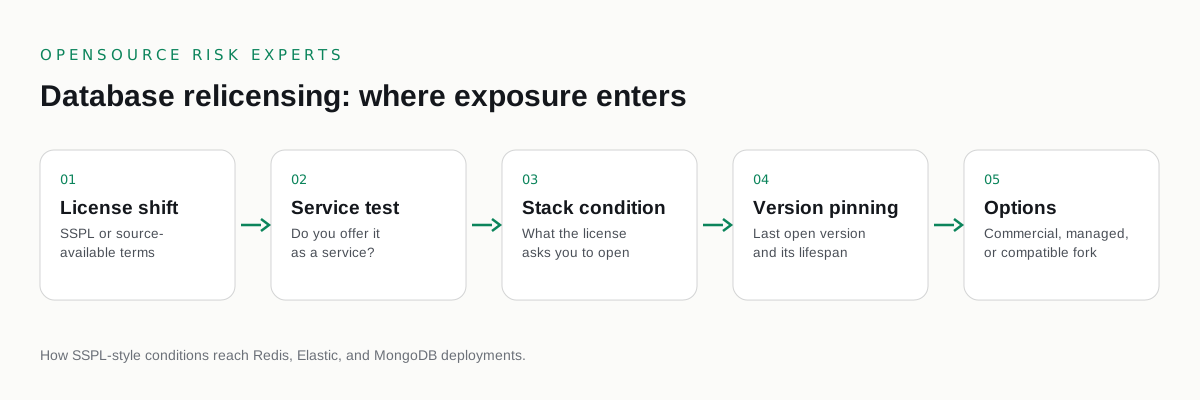
Why the caching tier is structurally exposed
Caching and in memory data components sit deep in the stack, which is exactly what makes a license change there expensive. They are usually adopted once, wired into many services, and rarely revisited. When the license under one of them moves, the change touches every service that depends on it, often without any code change to signal that something has shifted. The Redis move showed this clearly: a component that thousands of teams treated as permanent open source infrastructure turned out to be governed by a single vendor that could, and did, change the terms. The caching tier is exposed not because caches are special, but because they are widely embedded and seldom audited.
Which components carry the risk
The dividing line is governance, not technology. A caching or in memory component backed by a single commercial vendor carries the structural risk of a sudden relicense, because the vendor holds the rights. In memory data grids and certain message brokers with a commercial steward fall into this category. By contrast, components under broad community governance, such as Memcached under a permissive open source license, are less exposed to a unilateral change, because no single party can move the terms at will. This does not make community projects risk free, but it changes the shape of the risk. The first sorting step is to ask, for each caching component you run, who holds the right to change its license.
The same reasoning applies one tier over, in search and analytics and in newer data stores, which is why this is worth reading alongside search stack license risk beyond Elastic and vector database licensing risk to watch.
How to map caching layer license risk
The method is the same dependency mapping discipline applied to the caching tier. Inventory every cache, in memory store, and broker you run, direct and embedded inside other products. Record the current license for each and the date you confirmed it, because a license without a date is a guess. Mark which components are backed by a single commercial vendor and which are community governed. Flag anything already on source available terms, and note where each component is used so you can see the blast radius if its terms move. The output is a dated record that does double duty: it tells you your exposure today, and it acts as a sensor that alerts you when a caching component relicenses tomorrow. The Redis change is the proof that this sensor earns its cost.
Reducing exposure without overreacting
Mapping the risk does not mean ripping out every vendor backed cache. For most internal caching use, the source available restrictions that Redis adopted do not trigger, because they target offering the software to others as a service. The right response is proportionate: know what you run, favor components with open governance or a credible open fork where the choice is otherwise even, and avoid wiring a single vendor backed component so deeply that a future relicense leaves you with no leverage. Where a change has already created exposure, the options are an open fork such as Valkey for Redis, the AGPL path, or a negotiated commercial license, weighed on cost and effort. That weighing is the work of forking versus paying, the database decision.
This article is commercial and licensing risk advisory, not legal advice. For interpretation of any caching component license against your specific use, your own counsel is the right place to turn.
COMMON QUESTIONS
Questions buyers ask.
What is caching layer license risk beyond Redis?
Caching layer license risk beyond Redis is the exposure created when in memory stores, caches, and message brokers other than Redis change their license to source available terms. The Redis move as of March 2024 drew attention to the caching tier, but the same pattern can reach components such as Hazelcast, in memory grids, and brokers, so the risk is not limited to Redis.
Which caching components carry relicensing risk?
Any caching or in memory component backed by a single commercial vendor can relicense, because the vendor holds the rights to change terms. Redis moved to a dual Redis Source Available License and Server Side Public License model as of March 2024. Other in memory data grids and brokers with a commercial steward carry the same structural risk, while community governed projects such as Memcached are less exposed to a sudden change.
How do I map caching layer license risk?
Map caching layer license risk by inventorying every cache, in memory store, and broker you run, recording the current license and the date it was confirmed, identifying which are backed by a single commercial vendor, and flagging any already on source available terms. The same dated inventory that catches a Redis change catches the next caching component to move.
Is Memcached a safer choice than Redis?
Memcached remains under a permissive open source license and is community governed, which lowers the structural risk of a sudden relicense compared with a single vendor project. Whether it is a suitable replacement depends on feature needs such as persistence and data structures, so the license posture is one input among several rather than the whole decision.
Is this article legal advice?
No. This is commercial and licensing risk advisory, not legal advice. For interpretation of any caching component license against your specific use, engage your own counsel.
CONTAIN THE EXPOSURE
Map your caching tier before the next change lands.
A confidential open source license risk assessment. Independent, buyer side, paid only by you.
Not ready to talk? Read the free open source license risk guides first.
One email when a major project relicenses. No marketing, unsubscribe any time.
MORE IN THIS CLUSTER