REDIS, ELASTIC AND DATABASES
Search Stack License Risk Beyond Elastic
BY MORTEN ANDERSEN · REVIEWED BY FREDRIK FILIPSSON
By OpenSource Risk Experts · June 10, 2026
Search stack license risk beyond Elastic is the exposure most enterprises forget to check. Elasticsearch drew the attention because it was the largest and most visible relicensing event in search, but a modern search stack is far wider than one engine. It includes vector databases for retrieval, log and observability search, analytics query engines, and the ingestion and embedding components that feed them. Each of those layers has its own license trajectory, and several already sit on source available or commercial terms that can tighten under software you run today. This article maps where the risk concentrates across a search stack and how a buyer should approach it.
We write from the buyer side as an independent advisory paid only by the buyer. This is not legal advice. For interpretation of any specific engine license, we point you to your own counsel.
Why search engines attract relicensing
Search and retrieval engines share the trait that made databases a target. They are expensive to build, central to the products built on them, and easy for a cloud provider to wrap as a managed service. That combination gives a vendor both the incentive and the leverage to move from a permissive open source license to a source available one, restricting competitors from offering the engine as a service while keeping internal use largely permitted. Elasticsearch followed exactly this logic when it moved to the Server Side Public License and the Elastic License as of 2021. The same logic applies to the rest of the search stack, which is why the risk does not stop at Elastic.
The practical consequence is that a buyer who fixed the Elasticsearch question and moved on has addressed one engine in a stack of several. The next relicensing event in search is unlikely to be Elasticsearch again. It is more likely to be a vector engine or an analytics layer that an organization adopted recently and never license mapped, on the comfortable assumption that it was open source and would stay that way.
Where the risk concentrates in the stack
Three layers carry most of the search stack license risk. The first is vector search, which grew quickly alongside retrieval augmented generation and where several engines ship under a mix of open source, source available, and commercial editions. The open core pattern is common here, where the base is open but the features an enterprise actually needs sit behind a commercial license. The second is log and observability search, where the engines are tightly coupled to commercial platforms and the line between the open component and the paid product is easy to cross without noticing. The third is analytics and query engines, where distributed query layers and their managed editions carry their own field of use terms.
Underneath those engines sit the supporting components, ingestion pipelines, connectors, and embedding models, which often carry licenses distinct from the engine they feed. A search stack can therefore mix a permissive engine with a copyleft connector and a commercially licensed model, each with a different obligation. The exposure is not a single license question. It is a layered one, and it only resolves when you see the whole stack at once. We cover the adjacent emerging area in vector database licensing risk to watch.
Is OpenSearch a safe default for the engine layer?
For the core search engine, OpenSearch is the most common safe default. It runs under the Apache 2.0 license, which is permissive open source with no copyleft or service restriction, and it was created precisely so that organizations and providers could avoid the source available concerns at Elasticsearch. For many workloads it is the cleanest posture available. We compare the migration path in migrating from Elasticsearch to OpenSearch.
A safe engine does not make a safe stack, though. Standardizing the search engine on OpenSearch resolves one layer and says nothing about the vector store, the log search platform, or the analytics engine alongside it. The error to avoid is treating one well chosen open source component as evidence that the whole stack is clean. License posture has to be confirmed engine by engine, because the relicensing wave moves through categories one vendor at a time, not across an entire stack at once.
How relicensing spreads through a search stack
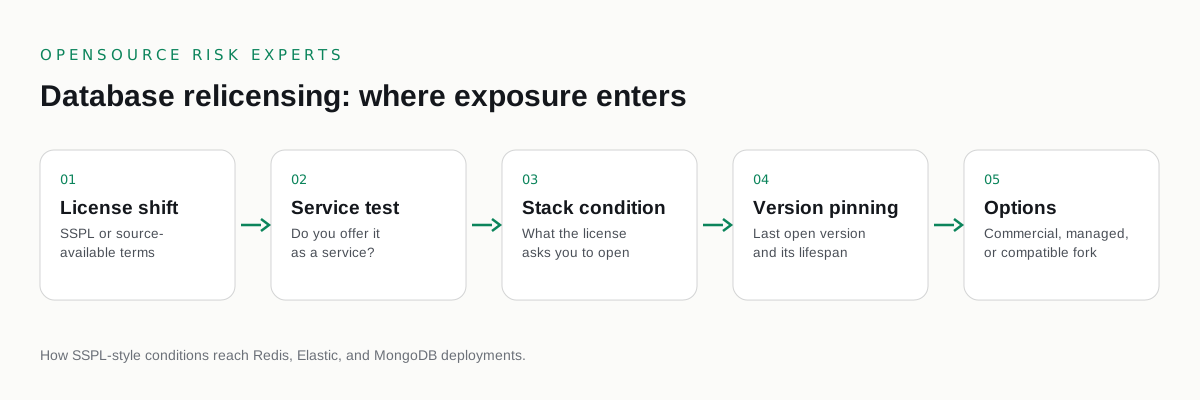
The reach of a single relicensing event in search is wider than the engine that changed. A search engine usually sits behind a service layer that many internal applications query, and those applications are in turn embedded in customer facing products. When the engine relicenses, the obligation can travel up that chain depending on how the software is deployed and offered. That is the blast radius, and in a search stack it can be long because retrieval is rarely a leaf dependency. It is foundational infrastructure with many things built on top of it.
This is why analytics and time series engines deserve the same scrutiny as Elasticsearch, a point we develop in time series and analytics database relicensing risk. The work of tracing the chain, and sizing the cost of each containment option, is the core of our open source remediation advisory, which maps each engine to a license and a defensible path.
What a buyer should do first
Inventory the entire search and retrieval stack, not just the headline engine. For each component, record the license, the edition, and the version, then flag every item on source available or commercial terms and every open core engine where the features you rely on sit behind a paid tier. Trace which services depend on each engine so you can size the blast radius. The result is a clear separation between the components that are genuinely permissive and stable and the short list that carries real or emerging exposure and needs a decision before the next change lands.
Search is too central to leave unmapped on the assumption that fixing Elasticsearch fixed the category. For the full landscape, see the Redis, Elastic, and database licensing pillar.
COMMON QUESTIONS
Questions buyers ask.
What is search stack license risk beyond Elastic?
It is the relicensing exposure in the wider set of search and retrieval engines an enterprise runs, not only Elasticsearch. Vector databases, log search platforms, and analytics engines have their own license trajectories, and several sit on commercial or source available terms that can change under software already in production.
Which parts of a search stack carry license risk?
The risk concentrates in the engine layer, where vendors have the most commercial incentive to restrict competing services. Vector search engines, log and observability search, and analytics query engines are the areas to watch, alongside the embedding and ingestion components that often ship under their own licenses.
Is OpenSearch a safe default for search?
OpenSearch runs under the Apache 2.0 license, which is permissive open source, so it avoids the source available concerns that prompted its creation. It is a strong default for many workloads, but a buyer should still confirm the license posture of every other engine in the stack rather than assume one safe component covers the rest.
How do I find search license risk across the stack?
Inventory every search and retrieval engine, record the license and version of each, and flag any on source available or commercial terms. Then trace which services depend on each engine so you can size the exposure. This is the same dependency mapping used for any open source license risk assessment.
Is this legal advice?
No. We provide commercial and licensing risk advisory, not legal advice. For interpretation of any specific search engine license and how it applies to your deployment, engage your own counsel.
CONTAINMENT
Map your whole search stack, not just Elastic.
A confidential open source license risk assessment. Independent, buyer side, paid only by you.
Not ready to talk? Read the free open source license risk guides first.
One email when a major project relicenses. No marketing, unsubscribe any time.
MORE IN THIS CLUSTER