RELICENSING
How a relicense affects production deployments.
BY MORTEN ANDERSEN · REVIEWED BY FREDRIK FILIPSSON
When a project changes license, the question that matters is not abstract. It is what changes for the software you already run. This article sets out how a relicense affects production deployments, which versions are reached, and how to contain it.
Commercial and licensing risk advisory, not legal advice.
Understanding how a relicense affects production deployments starts with separating two things that are easy to conflate: the code you have already deployed and the terms that govern future use of it. A license change does not reach back and rewrite the agreement on a binary you installed last year. What it does is change the terms on everything that comes next, and in a living system there is always something next. You patch, you upgrade, you scale, you adopt the latest release for a fix. Each of those moments is where the new license meets your production estate, and each is where unexamined exposure can take hold. The calm response is to know exactly which moments apply to you before they arrive.
This sits within the wider treatment on the pillar for open source relicensing, and pairs with the practical timeline in how to respond in the first 30 days of a relicense.
What actually changes for software you run
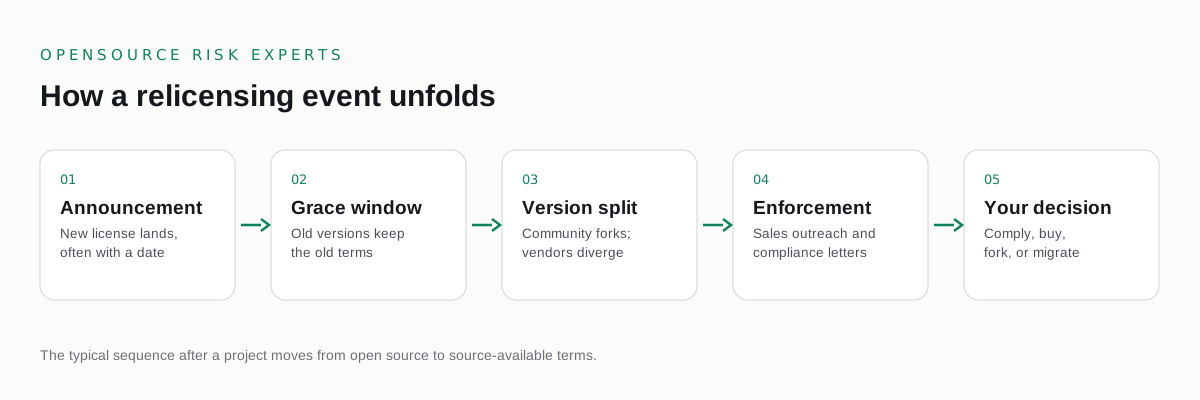
The immediate change is to the terms on new versions. When HashiCorp moved Terraform, Vault, Consul, Nomad, and Packer to the Business Source License as of August 2023, releases from that point carried the new license with its competitive use restriction. When Redis moved to a dual Redis Source Available License and Server Side Public License model as of March 2024, the same logic applied. For a production deployment, the practical effects fall into three buckets: your ability to upgrade under the old terms ends, support and security fixes flow only under the new license, and any use the new license treats as restricted becomes a live question. None of these forces an outage. All of them change the calculus of staying put versus moving.
The version you run is the hinge. A deployment frozen on a pre change release sits under the prior license, but it ages, and the pressure to take a fix only available under the new terms builds over time. What happens to those older versions is examined in what happens to old versions after a relicense.
Which production uses carry the most exposure
Not all production use is equally exposed. The source available licenses driving this wave target specific patterns. The Business Source License restricts competitive production use, which is aimed squarely at those who would offer the software as a rival commercial service. The Server Side Public License reaches further into service provision with its copyleft style obligations. So a deployment that runs the software purely for internal purposes often sits in a different risk band than one that exposes it to customers or builds a managed service on top of it. The line between internal and external use is therefore one of the first things to establish, a distinction explored in relicensing and internal versus external use.
Cloud and managed service deployments deserve particular care, because that is precisely the use these licenses were written to capture. If you run a relicensed component as part of a service you sell or operate for others, the exposure analysis is sharper, as set out in relicensing and cloud and managed service use.
Tracing the blast radius through the estate
A relicensed component rarely sits in one place. It is embedded in services, baked into container images, called from pipelines, and pulled in transitively by other dependencies. To understand how a relicense affects production deployments in your specific case, you have to trace every appearance of the component, not just the one you remember installing. This is the blast radius: the full set of systems and workflows that would be touched by the change. Map it before you decide anything, because the cost of staying, migrating, or negotiating all depend on how wide the radius runs. A change that looks contained at the surface often reaches much further once the transitive and pipeline appearances are counted.
The map is also what makes any later conversation defensible. Whether you are answering a vendor, briefing a board, or scoping a migration, a complete picture of where the component lives turns guesswork into evidence.
Containing the exposure without panic
Once you know which versions you run, which uses are exposed, and how wide the radius runs, the containment options become clear. You can stay on the prior version where your use is permitted and the loss of new releases is tolerable. You can migrate to an openly licensed fork, such as OpenTofu for Terraform or Valkey for Redis, where compatibility and maturity allow. Or you can negotiate a commercial license that reflects your actual usage rather than a list price. Most estates end up using more than one of these, applied component by component according to the exposure each carries. The point is that a relicense, handled with a map in hand, is a managed change rather than a crisis. None of the named events in this wave required a production outage to resolve.
How a relicense affects production deployments comes down to versions, use, and reach, and all three are knowable in advance of any forced decision. This article is commercial and licensing risk advisory, not legal advice. For interpretation of a specific license against your production use, your own counsel is the right place to turn.
COMMON QUESTIONS
Questions buyers ask.
How does a relicense affect production deployments?
A relicense changes the terms on new versions of the software, and the new restrictions can reach deployments you already run, depending on your use and the version you are on. The first effects are usually on upgrades, support, and any use the new license treats as competitive.
Do versions I already deployed keep their old license?
Versions released before the change generally keep the license they shipped under. The exposure arrives when you upgrade, patch, or adopt a new release, because those carry the new terms. Staying on an old version trades license stability for the loss of fixes and features.
Which production uses are most affected by a relicense?
Uses the new license treats as competitive, such as offering the software as a managed service, and uses that trigger copyleft or distribution obligations. Internal only use is often less exposed than redistribution or service provision, but the version and the specific license still decide it.
What should we do first when a dependency relicenses?
Confirm which version you run, read the new license against your actual use, and map every place the component appears. From there you can decide whether to stay on the prior version, migrate to a fork, or negotiate a commercial license.
Is this legal advice?
No. This article is commercial and licensing risk advisory, not legal advice. For interpretation of a specific license against your production use, we recommend your own counsel.
SEE YOUR EXPOSURE
Know what the change reaches in production.
A confidential relicensing exposure review. Independent, buyer side, paid only by you.
Not ready to talk? Read the free open source license risk guides first.
One email when a major project relicenses. No marketing, unsubscribe any time.
MORE IN THIS CLUSTER