RELICENSING
Open source relicensing FAQ: 20 questions.
This open source relicensing FAQ answers the twenty questions enterprises ask most when a project they depend on changes its license. The answers are plain, current as of June 2026, and written for the people who carry the risk rather than the people who wrote the license.
A relicense is rarely a crisis on its own. It becomes a crisis when an enterprise does not understand what changed, where it applies, and what the options are. This open source relicensing FAQ is built to remove that confusion. It runs from the basics through the practical decisions, and it links to deeper treatments where a question deserves more than a paragraph. Interpretation of any specific license is a matter for your own counsel.
The basics of relicensing
1. What is open source relicensing?
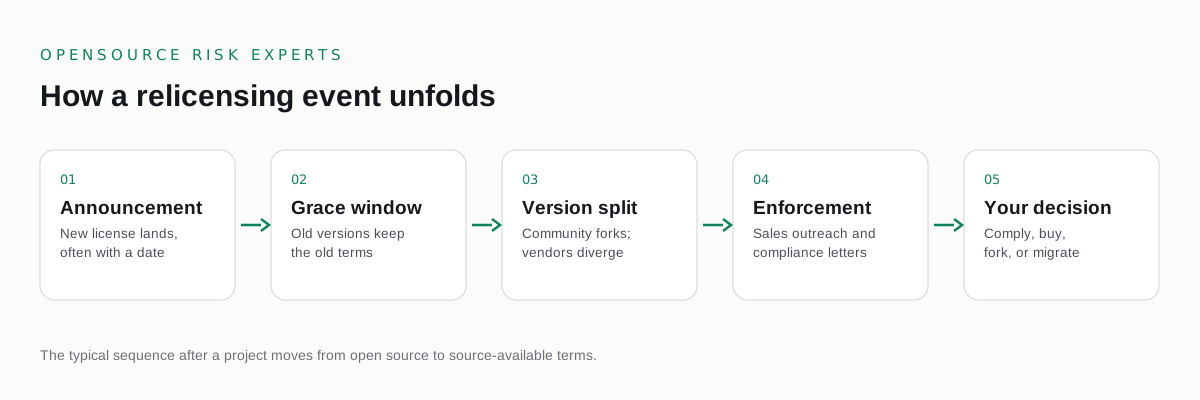
Open source relicensing is when a project changes the license governing its future releases, frequently from an open source license to a source available one. The new terms apply going forward, while past releases keep the license they were published under.
2. Can a project legally change its license?
A project that holds the necessary rights can change the license on its future releases. It cannot revoke the grant already made on past releases. That permanence is exactly what makes community forks of the last open version possible.
3. Why are so many projects relicensing now?
The common driver is commercial. Maintainers who built a business around an open source project found that cloud providers could offer the software as a service and capture much of the revenue. Source available licenses are an attempt to recapture that value by restricting competitive use.
4. Does a relicense affect versions I already deployed?
The version you deployed stays under the license it shipped with. Exposure usually arrives when you upgrade to a release carrying the new terms, or when a container image or transitive dependency pulls the new version in for you.
The licenses involved
5. What are the main licenses in recent relicensing?
The Business Source License and the Server Side Public License lead the recent wave. Neither is approved by the Open Source Initiative, and both restrict use in ways an open source license would not. For the wider context, see why source available is not open source.
6. What does the Business Source License restrict?
The Business Source License restricts competitive production use and converts to an open license after a delay, commonly four years. You may read and use the code within the stated limits, but not to offer a competing product or service until the conversion date passes.
7. What does the Server Side Public License restrict?
The Server Side Public License carries a service condition: offer the software to third parties as a service and you must release a broad set of surrounding source under the same license. The effect targets managed service providers. See the competitive restrictions in the SSPL.
8. Is source available the same as open source?
No. Source available means the code is visible but the license restricts how you may use it. Open source, as defined by the Open Source Initiative, grants the freedom to use the software for any purpose. The two are not interchangeable.
The well known cases
9. What did HashiCorp change?
As of August 2023 HashiCorp moved Terraform, Vault, Consul, Nomad and Packer from an open source license to the Business Source License 1.1. IBM later acquired HashiCorp. The community fork of Terraform is OpenTofu.
10. What did Redis change?
As of March 2024 Redis moved from an open source license to a model that includes a source available license and the Server Side Public License, and later added an open license option. The community fork is Valkey.
11. What did Elastic change?
Elasticsearch and Kibana moved from Apache 2.0 to the Server Side Public License and the Elastic License in 2021, and later added an open license option. The AWS led fork is OpenSearch. See the OpenSearch fork story.
12. What did MongoDB change?
MongoDB moved to the Server Side Public License in 2018, the first major project to adopt it. The change set the pattern that several later projects followed.
Forks and alternatives
13. What is a community fork?
A community fork takes the last release under the open license and continues development from it under that license. OpenTofu, Valkey, and OpenSearch are the leading examples, each created in response to a relicense.
14. Is a fork a safe choice?
A fork removes the source available restriction, which is the main goal, but it carries its own risk. A fork with strong backing and an active community is a credible path. A fork that stalls becomes a maintenance burden, so the health of the project matters as much as its license.
15. Is a fork a drop in replacement?
At creation a fork is identical to the original, but the two diverge over time. Treat a migration as scoped engineering work with testing, not as a swap, especially where you depend on newer features of the relicensed product.
16. Can I just stay on the old open version?
Sometimes, for a while. The last open release stays under its license, but it stops receiving security patches and features. Staying is a holding position with a shelf life, not a permanent answer.
What to do about your exposure
17. What should I do first if a project I use relicenses?
Find every place you run it and record the version and license state of each, including inside container images. Then describe how you deploy it, size the exposure, and weigh the options. The relicensing pillar sets out the full method.
18. How do I size the exposure?
Trace the blast radius through everything built on the affected component, then estimate two numbers: the cost if the new terms apply to you, and the cost to remediate. The comparison drives the decision and gives a board something it can act on.
19. Should I negotiate a commercial license?
Sometimes a commercial license is the right answer, particularly where migration is costly and use is heavy. Negotiate from your actual usage and leverage, and remember that a credible fork strengthens your position at the table.
20. When should I bring in outside help?
Bring in independent, buyer side help when the exposure is material, when it spans many teams, or when a deal or audit is in view. The value of an outside advisor is a defensible map and a sized choice, paid for by you alone. For interpretation of the license text itself, your own counsel is the right call.
COMMON QUESTIONS
Questions buyers ask.
What is open source relicensing?
Open source relicensing is when a project changes the license that governs its future releases, often from an open source license to a source available one. The new terms apply to new versions, while past releases remain under the license they were published under.
Can a project legally change its license?
A project that holds the necessary rights can change the license on its future releases. It cannot revoke the license already granted on past releases, which is why community forks of the last open version are possible.
Does a relicense affect versions I already deployed?
The version you deployed stays under the license it shipped with. Exposure usually arrives when you upgrade to a release that carries the new terms, or when an image or dependency pulls the new version in for you.
What are the main licenses involved in recent relicensing?
The Business Source License and the Server Side Public License are the leading source available licenses in recent changes. Neither is approved by the Open Source Initiative, and both restrict use in ways an open source license would not.
What should I do first if a project I use relicenses?
Find every place you run it and record the version and license state of each. Then describe how you deploy it, size the exposure, and weigh the options: migrate to a fork, remove the dependency, or negotiate a commercial license. Put interpretation questions to your own counsel.
Is this article legal advice?
No. It is commercial and licensing risk analysis, not legal advice. For interpretation of license terms, engage your own counsel.
CONTAINMENT
Turn a relicense into a sized decision.
A confidential relicensing exposure review. Independent, buyer side, paid only by you.
Not ready to talk? Read the free open source license risk guides first.
One email when a major project relicenses. No marketing, unsubscribe any time.
MORE IN THIS CLUSTER