ARTICLE . UPDATED JUNE 2026
Relicensing and the Right to Fork
BY MORTEN ANDERSEN · REVIEWED BY FREDRIK FILIPSSON
Relicensing and the right to fork are tied together by one fact: a vendor can change the terms of future releases, but it cannot reach back and revoke the open license on code it already published. That fact is what lets a community take the last open version and continue it. OpenTofu, Valkey, and OpenSearch all began this way. The right to fork is real, but a fork is a project, not a free lunch.
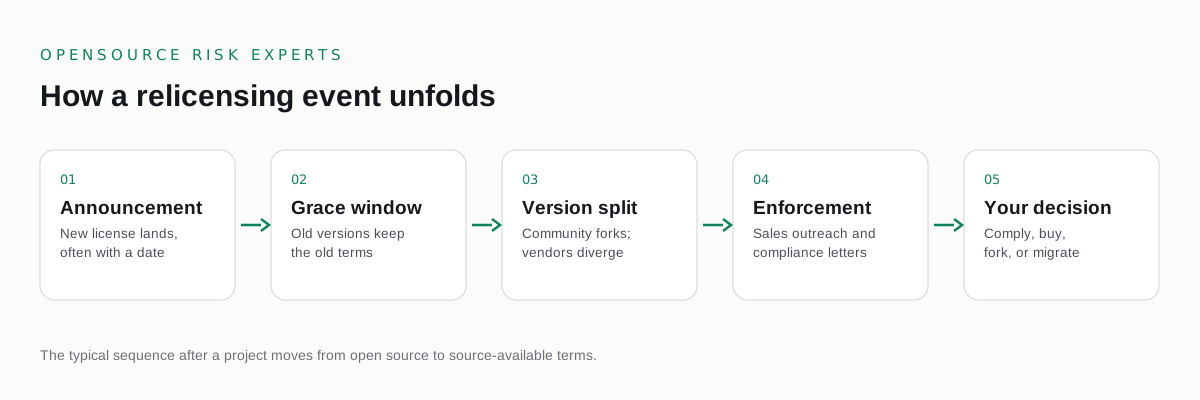
When a vendor relicenses a project, the first question a buyer asks is whether anything can be done about it. The answer rests on a property of open source that survives the change. Code released under an open license carries that license with it permanently. A later decision to publish new versions under different terms does not erase the license on what came before. This is the legal foundation of the right to fork, and it is why every major relicense of the current wave produced a community continuation rather than a dead end.
Why the pre change code stays open
A relicense applies going forward. The version of a project that was published under an open license such as the Mozilla Public License or Apache 2.0 remains available under those terms. A vendor cannot, as a general matter, retroactively revoke a license that recipients already hold. So at the moment of a relicense there are two versions of the project: the last release under the old open license, which anyone may take and build on, and the new releases under the changed terms. The community fork starts from that last open commit and carries the open license forward. The fork is therefore not a workaround or a loophole. It is the open license doing exactly what it was written to do.
This is also why the effective date of a relicense matters so much. Everything before it is open. Everything after it is under the new terms. The precise boundary, and what depends on it, is covered in notice and effective dates in a relicense.
The forks the current wave produced
The recent relicensing events each generated a fork. As of August 2023, HashiCorp moved Terraform, Vault, Consul, Nomad, and Packer to the Business Source License 1.1, and the community continuation of Terraform is OpenTofu, now under a neutral foundation. Redis moved to a dual model with the Server Side Public License as of March 2024, and the fork is Valkey, which continued the last open version of Redis under an open license. Elasticsearch and Kibana moved to the Server Side Public License and the Elastic License as of 2021, and the fork led by a major cloud provider is OpenSearch. Each of these started from the last open release and carries an open license, which is the right to fork in practice. The fuller history of two of them is covered in the OpenTofu and Valkey fork story.
What a fork solves and what it does not
A fork removes the license restriction. If your concern is the competitive use limits of the Business Source License or the service obligations of the Server Side Public License, moving to an open fork takes that concern off the table, because the fork carries an open license that the Open Source Initiative recognizes. That is a real and often decisive benefit. Source available is not open source, and a fork lets a buyer return to genuine open source terms.
What a fork does not remove is the work. Adopting a fork is a migration with its own engineering cost, testing burden, and operational risk. It also asks the buyer to bet on the fork's long term health: its governance, its pace of development, and whether the community sustains it. A young fork backed by a neutral foundation is a different proposition from one that depends on a single sponsor. None of this makes forking wrong. It makes forking a decision that should be weighed against the alternatives rather than assumed to be free.
Weighing the fork against the other paths
The right to fork is one option among several. The others are negotiating a commercial license with the vendor, moving to a different alternative entirely, or holding the relicensed version as a known and contained position. The correct choice depends on how widely the affected component sits in your estate and how much migration you can absorb. A component with a small blast radius may be cheapest to fork. One that is deeply wired into many products may be cheaper to license commercially while a longer migration is planned. The way these paths are compared on a common basis sits on the relicensing pillar, and the fork itself is often confused with the broader point that source available is not open source.
A relicensing exposure review sizes each path so the fork decision is made on evidence rather than instinct. We are independent and buyer side. We take no vendor fees and resell no software, so the recommendation reflects your exposure and nothing else. This is commercial and licensing risk advisory, not legal advice. For interpretation of your right to fork in a specific situation, engage your own counsel.
COMMON QUESTIONS
Questions buyers ask.
What is the right to fork after a relicense?
The right to fork rests on the fact that code already released under an open license stays under that license. A vendor can change the terms of future releases, but it cannot retroactively revoke the open license on code already published. The community can take the last open version and continue it as a separate project, which is exactly how OpenTofu, Valkey, and OpenSearch began.
Can a vendor take back code it already released as open source?
Generally no. A relicense applies to new releases going forward. The version published under the prior open license remains available under those terms, which is the legal foundation that lets a fork start from the last open commit. The interpretation of any specific situation is a question for your own counsel.
What are the major forks created by relicensing?
OpenTofu forked from Terraform after HashiCorp moved to the Business Source License as of August 2023. Valkey forked from Redis after the move to the Server Side Public License as of March 2024. OpenSearch forked from Elasticsearch after the move to the Server Side Public License and the Elastic License as of 2021. Each continues the last open version under an open license.
Does forking solve the whole problem?
Not entirely. A fork removes the license restriction, but it introduces a migration project, a new upstream to track, and a bet on the fork's long term health and governance. For some buyers the fork is the cleanest path. For others a commercial license or a different alternative is better. The right answer depends on your blast radius and your tolerance for migration.
Is this legal advice?
No. This is commercial and licensing risk advisory, not legal advice. For interpretation of license terms and your right to fork in a specific situation, we recommend you engage your own counsel.
CONTAINMENT
Know whether forking is your best path.
A confidential relicensing exposure review. Independent, buyer side, paid only by you.
Not ready to talk? Read the free open source license risk guides first.
One email when a major project relicenses. No marketing, unsubscribe any time.
MORE IN THIS CLUSTER