GOVERNANCE AND SBOM
Continuous Open Source License Monitoring
BY FREDRIK FILIPSSON · REVIEWED BY MORTEN ANDERSEN
By OpenSource Risk Experts · May 10, 2026
Continuous open source license monitoring is the practice that turns a relicensing event from a surprise into a notification. The components you depend on are not static. Their terms can change long after you adopt them, and the relicensing wave proved that the change can arrive years into a stable deployment. A buyer who checks a license once, at adoption, has confirmed only the terms of that day. A buyer who monitors continuously learns the moment a dependency moves, while there is still time to respond on their own terms. This article explains what continuous monitoring watches, why point in time checks fall short, and how monitoring sits inside a wider governance program.
We write from the buyer side as an independent advisory paid only by the buyer. This is not legal advice. For interpretation of a detected license change and your obligations under it, we point you to your own counsel.
What continuous open source license monitoring means
Continuous open source license monitoring is the ongoing observation of the license state of every dependency in your estate, direct and transitive, so that any change in terms is detected as it happens. It rests on two parts working together. The first is a live inventory, a current map of what you run and the license each component carries. The second is an automated check that compares the observed license state against the last known state and your policy, raising a flag whenever something moves. The combination means that a new dependency, a version bump that carries new terms, or a relicensing of a component already in use is surfaced promptly rather than discovered late. Monitoring does not replace the inventory or the policy. It is the layer that keeps watch over both.
The value of monitoring is time. The cost and disruption of responding to a relicensing event scale with how late you find out. Caught early, a change is a planning input. Caught in an audit or a vendor demand, the same change is a crisis with a deadline attached. Continuous monitoring buys the early warning that makes a measured response possible.
Why point in time checking is not enough
Many organizations check a license once, when a component is first brought in, and then never again. That single check confirms the terms on the day it was done and nothing more. The relicensing wave is the clearest evidence of why this is insufficient. HashiCorp moved Terraform, Vault, Consul, Nomad, and Packer to the Business Source License as of August 2023, years after most users had adopted them under an open license. Redis moved to a source available model as of March 2024. Elasticsearch and Kibana moved to the Server Side Public License as of 2021. In each case the terms that mattered changed long after the point in time check would have passed. An organization relying on that one check would have carried the new terms in production, unaware, until something forced the discovery. Continuous monitoring is the only approach that catches a change which lands after your last review, because it never stops reviewing.
What monitoring should watch for
Effective monitoring watches three kinds of movement. The first is new dependencies entering the estate, since every addition brings a license that must be checked against policy before it reaches production. The second is version changes, because a new release of a component you already use can carry different terms than the version you reviewed, and the change can hide in a transitive dependency several layers down. The third, and most consequential, is a license change on a component already in use, the relicensing event itself, where the software stays the same but the terms governing it shift. A monitoring practice that covers all three closes the gaps through which a problem usually slips. It is the transitive layer that catches teams out most often, because a component deep in the tree can relicense without any visible change in the dependencies a team thinks it manages. Monitoring that sees the full tree, to the depth a proper bill of materials reaches, is what makes those deep changes visible. We cover keeping that tree current in maintaining an accurate SBOM, and the automation behind it in open source inventory automation.
How monitoring fits inside a governance program
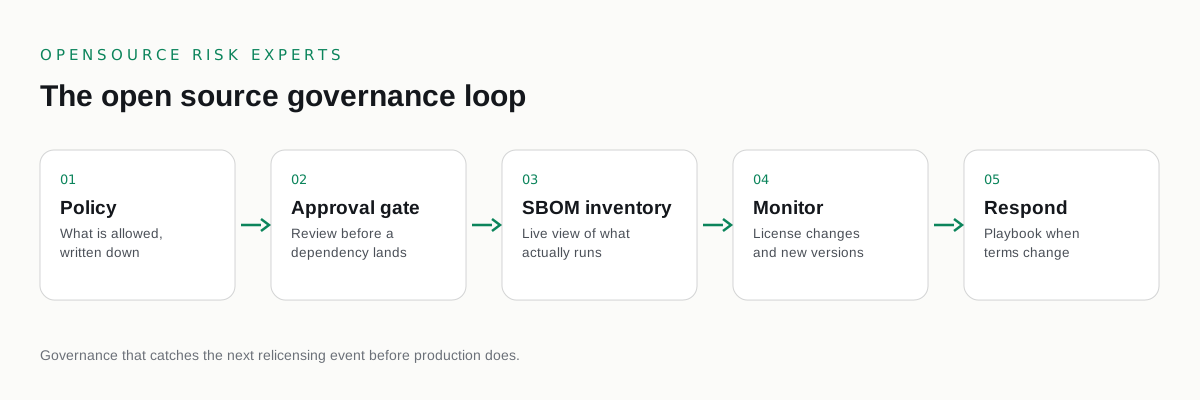
Continuous monitoring is the detection layer of a complete governance program, and it works only alongside the other layers. Policy sets the rules, defining which licenses are acceptable and what happens when one is not. Approval gates enforce those rules at intake, stopping a non compliant component before it enters. Monitoring then confirms that what is actually running still complies, catching the two things intake gates cannot: drift, where usage spreads beyond what was approved, and external license changes, where a component already inside the gate has its terms changed by its owner. Without monitoring, a governance program is blind to anything that changes after approval. With it, the program stays accurate over time rather than only at the moment of intake. The approval side of this pairing is covered in open source approval workflows for developers.
Designing and standing up continuous license monitoring as part of a governance program is the work of our open source governance and policy service. For the full picture of governance and software bill of materials practice, see the governance and SBOM pillar.
COMMON QUESTIONS
Questions buyers ask.
What is continuous open source license monitoring?
Continuous open source license monitoring is the practice of watching the license state of every dependency you run, on an ongoing basis, so that a change in terms is detected when it happens rather than during an audit. It pairs a live inventory with automated checks that flag any license that moves.
Why is point in time license checking not enough?
Because a license can change after you adopt a component. A one time check confirms the terms on the day you looked, but the relicensing wave showed that terms shift, sometimes years into a deployment. Only continuous monitoring catches a change that lands after your last review.
What should license monitoring watch for?
It should watch for new dependencies entering the estate, version changes that carry new terms, and license changes on components already in use, such as a move to the Business Source License or the Server Side Public License. The aim is to surface any of these before they reach production unreviewed.
How does monitoring fit with governance?
Monitoring is the detection layer of a governance program. Policy sets the rules, approval gates enforce them at intake, and continuous monitoring confirms that what is actually running still complies, catching drift and external license changes that intake checks alone would miss.
Is this legal advice?
No. We provide commercial and licensing risk advisory, not legal advice. For interpretation of a detected license change and your obligations under it, engage your own counsel.
PREVENTION
Catch the next relicense the day it lands.
A confidential open source license risk assessment. Independent, buyer side, paid only by you.
Not ready to talk? Read the free open source license risk guides first.
One email when a major project relicenses. No marketing, unsubscribe any time.
MORE IN THIS CLUSTER