ARTICLE / GOVERNANCE AND SBOM
Open source approval workflows for developers.
BY FREDRIK FILIPSSON · REVIEWED BY MORTEN ANDERSEN
Open source approval workflows for developers are how you catch the next relicense at intake instead of in an audit. This guide shows how to build gates that approve the safe majority automatically and stop the risky few, without slowing the teams that ship.
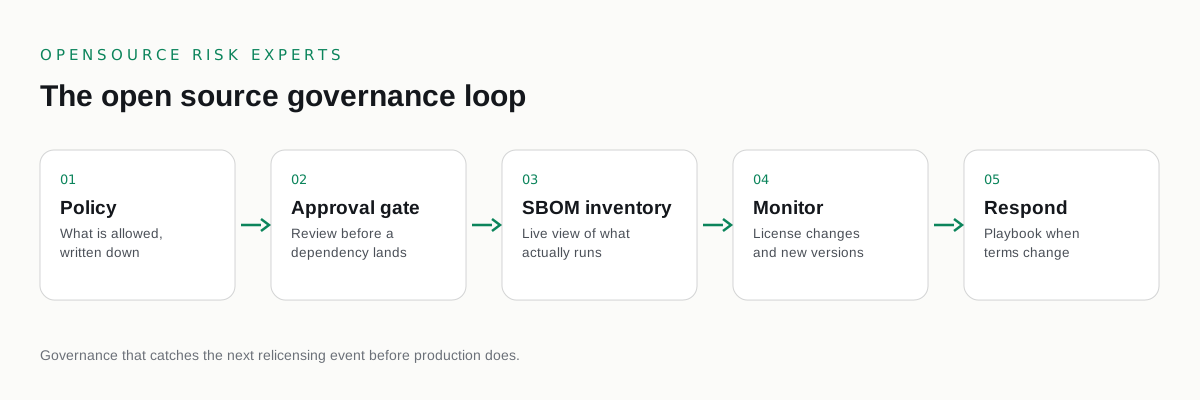
The relicensing wave taught a hard lesson: a component you adopted under an open license can change terms while it sits in production. The defense is not a stricter policy document. It is a working approval flow that engineers actually pass through, one that checks license state at the moment a dependency enters and again whenever it changes. Open source approval workflows for developers turn governance from a quarterly review into a control that runs every day, at the point of decision, where it can prevent exposure rather than discover it.
Open source approval workflows for developers approve the safe majority automatically
The first principle is speed for the common case. Most dependencies a developer adds carry a well understood permissive license that needs no human review. Define a clear allowlist, commonly Apache License 2.0, MIT, and BSD, and let anything on it pass automatically. When the safe majority sails through, the workflow earns the credibility to stop the few that matter. A gate that questions every dependency trains engineers to route around it, and a control that gets bypassed protects nothing. Automate the yes so you can afford to mean the no.
Flag restricted and unknown licenses for review
The other side of the allowlist is the review list. Copyleft licenses such as the GNU AGPL and source available licenses such as the Business Source License and Server Side Public License carry obligations or restrictions that deserve a deliberate decision before adoption. So does any license the scanner cannot identify, because an unknown license is an unmeasured risk. These cases route to a named reviewer with the context attached, so the decision is fast and recorded. The split between allow, review, and block should reflect your risk tolerance and your own counsel's guidance on what each license actually requires. We define the source available category in the source available license glossary entry.
Put the gate where developers already work
A workflow only governs what passes through it. The way to guarantee that is to place the check in the pull request and the build pipeline, not in a separate ticket queue that developers must remember to visit. When the scan runs on every change and reports back in the same interface where code review happens, approval becomes part of shipping rather than a detour from it. The component is checked because the pipeline checks it, not because a person chose to. This is also where a relicense in a later version gets caught, since the gate re evaluates license state on every dependency update.
Catch the relicense, not just the new adoption
Intake control alone is not enough, because the riskiest change is the one to a component you already trust. A project you adopted years ago under an open license can move to a restricted one in a new release, and a workflow that only checks at first adoption will wave that change straight through. The fix is continuous evaluation: re check license state on every version bump and surface a change in terms as a flag, the same way a new restricted dependency would be. This connects the approval flow to your living inventory, which we cover in building an open source license inventory.
Tie the workflow to procurement and the SBOM
Developer intake is one door, but components also arrive through vendor software and procurement, so the approval workflow should connect to those processes rather than stand apart from them. A license check that fires when engineering adopts a library, and again when procurement onboards a vendor, closes the gaps a relicense exploits. The record the workflow produces feeds the software bill of materials, which is the same map that satisfies a regulator and finds a relicensed component fast. We cover the procurement link in relicensing and procurement approval processes, the mapping discipline in SBOM and dependency mapping, and the full frame in our pillar on open source governance and SBOM. Which licenses to allow or block is a question for your own counsel.
COMMON QUESTIONS
Questions buyers ask.
What are open source approval workflows for developers?
Open source approval workflows for developers are the intake controls that decide whether a new dependency can be adopted. They check the license against an allowlist, flag source available or restricted licenses for review, and record the decision. Done well they run inside the tools engineers already use and approve most components automatically, reserving human review for the few that need it.
How do approval workflows catch a relicense?
A workflow catches a relicense at two points: at intake, when a new component is added, and on refresh, when an existing component changes license in a later version. By checking license state continuously rather than only at adoption, the workflow flags a move to the Business Source License or Server Side Public License before it reaches production rather than during an audit.
How do I keep approval gates from slowing developers?
Automate the common case. Pre approve a clear allowlist of permissive licenses so most dependencies pass without friction, and reserve manual review for restricted or unknown licenses. Put the gate in the pull request and build pipeline rather than a separate ticket queue. A workflow that approves the safe majority instantly earns the right to stop the risky few.
What belongs on a license allowlist?
An allowlist usually contains well understood permissive licenses such as Apache License 2.0, MIT, and BSD, which carry low obligation for most uses. Copyleft licenses such as the GNU AGPL and source available licenses such as the Business Source License and Server Side Public License sit on a review or block list. The exact split should reflect your risk tolerance and your own counsel's guidance.
Are approval workflows legal advice?
No. This is commercial and licensing risk advisory, not legal advice. For the interpretation of which licenses to allow, review, or block, and what obligations they carry, we recommend your own counsel.
GOVERNANCE AND POLICY
Build approval gates that engineers use.
Our governance advisory wires license allowlists and intake gates into how your teams ship. Independent, buyer side, paid only by you.
Not ready to talk? Read the free open source license risk guides first.
One email when a major project relicenses. No marketing, unsubscribe any time.
MORE IN THIS CLUSTER