ARTICLE / UPDATED JUNE 17 2026
Developer Education on License Risk
BY FREDRIK FILIPSSON · REVIEWED BY MORTEN ANDERSEN
Developer education on license risk moves the first line of defense to where adoption decisions are actually made. This article covers what engineers need to know, where those decisions go wrong, and how to teach it without turning developers into lawyers.
Open source enters your codebase one decision at a time, and most of those decisions are made by a developer adding a dependency. That is why developer education on license risk is not a nice to have. It is where governance either works or fails. A policy that lives in a document and a scanner that runs after the fact both arrive late if the engineer who pulled in a copyleft or source available component never recognized the risk. Educating developers puts a thinking person at the exact moment the exposure would otherwise enter unnoticed. This article sets out what to teach, where adoption goes wrong, and how to deliver the training so it actually changes behavior.
The article sits under the pillar on governance and SBOM and supports our open source governance and policy service. It works alongside the approval and intake controls covered in open source approval workflows for developers.
What developers actually need to know
The goal is triage, not legal mastery. Developers do not need to interpret license clauses, and asking them to would be both unfair and ineffective. They need enough to recognize when a dependency carries risk and when to escalate. That starts with the families: permissive licenses such as the MIT License and Apache License 2.0, which are usually low risk; copyleft licenses such as the GNU GPL and AGPL, which attach obligations, especially on distribution; and source available licenses such as the Business Source License and the Server Side Public License, which restrict use and are not open source at all. A developer who can place a license in the right family already catches most of the risk.
Two ideas matter most. The first is that source available is not open source, a distinction many engineers do not know until it bites. A component labeled freely available may carry real restrictions on production or competitive use. The second is that distribution can change everything, because shipping software to others can trigger obligations that internal use does not. Beyond those, developers need to know one thing above all: when in doubt, escalate rather than decide alone. The glossary entries on the source available license and the Business Source License are useful reference points to share.
Where adoption decisions go wrong
Most license problems trace back to a few predictable patterns at adoption time. A developer reaches for the most popular package without checking its license. A transitive dependency arrives unnoticed, pulled in by something else. A component that was safe when adopted relicenses later, and no one is watching the version that changed terms. A library is copied in by hand, bypassing the package manager and any tool that would have caught it. None of these reflect carelessness so much as a gap in awareness, and awareness is exactly what education closes.
The relicensing wave gives these patterns real weight. An engineer who adopted Terraform, Redis, or Elasticsearch years ago under an open license made a sound decision at the time. The terms changed underneath that decision when HashiCorp moved to the Business Source License as of August 2023, Redis moved to the Redis Source Available License and the Server Side Public License as of March 2024, and Elasticsearch and Kibana moved to the Server Side Public License and Elastic License in 2021. Educated developers are more likely to flag such a change when they see it in a release note, and to know that the community forks, OpenTofu, Valkey, and OpenSearch, exist as alternatives worth raising.
The aim is not to make developers cautious about every dependency. It is to make them notice the few that matter and know exactly who to ask. Recognition plus a clear escalation path is the whole of it.
How to teach it so it sticks
Effective license education is short, practical, and wired into the workflow. A focused session that teaches the license families and the escalation path beats a long policy document that no one finishes. Pair the session with a clear allowlist of licenses that are pre approved, so the common case needs no thought, and a fast, low friction way to ask about anything outside it. When the easy path is also the compliant path, developers follow it without resentment. The policy that backs this is covered in open source policy: what to include.
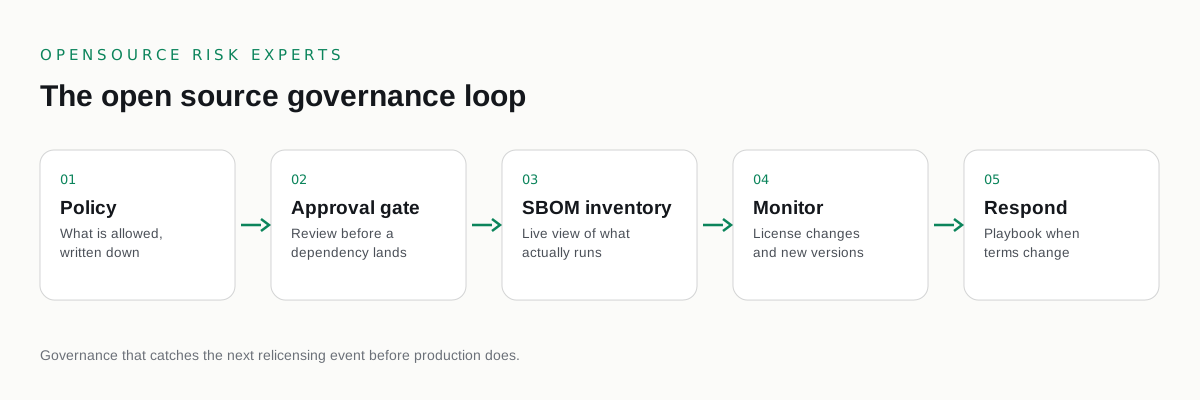
Education does not stand alone. It works with software composition analysis, which catches what people miss, and with policy, which sets the rules. Tooling without educated developers floods the team with flags no one understands. Educated developers without tooling miss the transitive dependencies no human tracks. Together, with a program office to own the whole, they form a defense that holds. Developer education is the human layer, and it is the one that operates earliest, at the moment of choice, before any scan or review has a chance to intervene.
RELATED READING
COMMON QUESTIONS
Questions buyers ask.
Why does developer education on license risk matter?
Developers make most open source adoption decisions, often at the moment they add a dependency. If they cannot recognize a risky license, the exposure enters the codebase before any review. Educating engineers moves the first line of defense to where the decision actually happens.
What do developers need to know about open source licenses?
Enough to triage, not to interpret. Developers should recognize the difference between permissive, copyleft, and source available licenses, know that source available is not open source, understand that distribution can trigger obligations, and know when to escalate rather than decide alone.
How should license education be delivered?
Short, practical, and tied to the workflow. A focused session, a clear allowlist, and a fast escalation path beat a long policy document no one reads. The aim is recognition and a known next step, not legal depth.
Does developer education replace tooling and policy?
No. Education, software composition analysis, and policy work together. Tooling catches what people miss, policy sets the rules, and education helps developers make good calls before either has to intervene. Each is weaker without the others.
Is this legal advice?
No. This is commercial and licensing risk advisory, not legal advice. For interpretation of license terms and compliance questions, engage your own counsel.
PREVENT
Catch license risk at the moment of choice.
Build education into your governance program. Independent, buyer side, paid only by you.
Not ready to talk? Read the free open source license risk guides first.
One email when a major project relicenses. No marketing, unsubscribe any time.
MORE IN THIS CLUSTER