GOVERNANCE AND SBOM
Open source governance for regulated industries.
BY FREDRIK FILIPSSON · REVIEWED BY MORTEN ANDERSEN
In a bank, an insurer, or a healthcare provider, a license change is not only a cost question. This article covers open source governance for regulated industries: how to meet examiner expectations and prove that a relicense was managed under control.
Commercial and licensing risk advisory, not legal advice.
Open source governance for regulated industries carries a second audience that other organizations do not face. Alongside the vendor and the auditor sits the examiner, and the examiner is interested less in whether you ran a relicensed component than in whether you managed it under a documented control. That changes the standard. It is no longer enough to handle a license change well; you have to be able to show, on demand, that it was handled under policy, with evidence, and with a record an examiner can follow. For a bank, an insurer, or a healthcare provider, the absence of that record can read as a control failure in its own right, separate from any commercial exposure.
The foundations are the same governance and inventory disciplines every organization needs, raised to an evidentiary standard. Those foundations are set out in the pillar on open source governance and SBOM, and the function that carries them is the subject of building an open source program office.
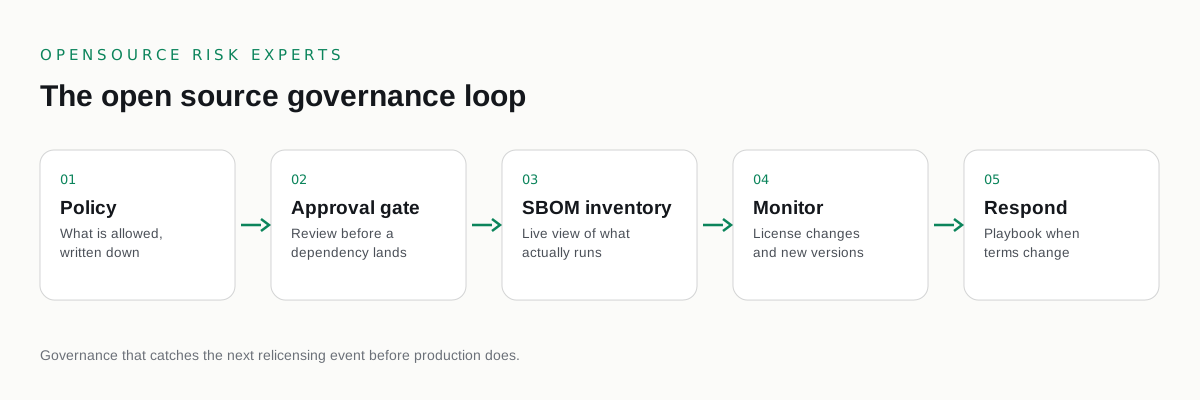
Why open source governance for regulated industries raises the bar
Regulators examine controls, not intentions. A relicense touches several of the control areas they care about: third party and vendor risk management, change management, and increasingly software supply chain integrity. When the terms governing a component in a critical system change, an examiner will want to see that the change was detected, assessed, and addressed within an existing process. A firm that can produce that trail demonstrates a working control. A firm that managed the change informally, however competently, has a harder story to tell, because competence that leaves no record is difficult to evidence under examination.
The precise obligations differ by regulator and jurisdiction, and the interpretation of any specific rule belongs to your own counsel and compliance team. The advisory contribution is to make the underlying risk visible and the response documentable, so that whatever standard applies can be met with evidence rather than assertion.
Build governance that produces evidence by default
The defining trait of governance in a regulated setting is that it generates its own evidence as a byproduct of operating. A dated inventory with the license state of each component is not just an operational tool; it is the record that shows what you ran and when. An intake gate that logs each approval is not just a control; it is the proof that the control existed and fired. Monitoring that records when a license change was detected is not just an alert; it is the timestamp that shows you found the change rather than the examiner finding it for you. Designing the governance so that doing the work produces the documentation removes the scramble that otherwise precedes every examination.
This is where maturity matters, because evidence quality tracks process maturity. A governance program that has reached a repeatable, measured state produces consistent evidence, while an ad hoc one produces gaps. Assessing where a program sits is the purpose of an open source governance maturity model.
Keep the inventory examiner ready, not just current
A current inventory and an examiner ready inventory are not the same thing. Current means it reflects what you run today. Examiner ready means it also preserves history: what you ran at past points in time, when a component's license changed, and what you did about it. Regulators frequently ask about a moment in the past, not only the present, so an inventory that overwrites itself with each scan answers half the question. The record has to be able to show the state of the estate as it was, which means retaining dated snapshots and the decisions attached to them. That retention is a governance choice that has to be made deliberately, because most tooling defaults to showing only the latest view.
Keeping that history accurate without manual effort is the same automation problem every organization faces, with a higher tolerance bar. The mechanics are covered in open source inventory automation.
Connect license risk to the controls examiners already test
Open source license risk lands more cleanly when it is mapped to control frameworks the firm already maintains rather than treated as a separate program. A relicense is a third party risk event, a change management event, and a supply chain event all at once, and each of those already has an owner, a process, and a place in the examination. Routing license risk through those existing controls means the evidence sits where examiners look for it, and the response inherits a process that is already understood and tested. Building a parallel structure outside the established framework tends to create gaps at exactly the seams an examiner probes.
Open source governance for regulated industries is governance that can prove itself. Build controls that generate evidence as they run, keep an inventory that preserves history as well as the present, and connect license risk to the frameworks examiners already test. This article is commercial and licensing risk advisory, not legal advice. For interpretation of a specific regulation or license, your own counsel and compliance team are the right place to turn.
COMMON QUESTIONS
Questions buyers ask.
Why does open source governance for regulated industries differ from general governance?
Regulated industries face an examiner as well as a vendor. Governance has to produce evidence on demand, document controls, and show that a license change was managed under policy. The bar is not just managing the risk but proving it was managed.
What do regulators expect around open source license risk?
Expectations vary by regulator, but the common thread is documented control: a current inventory, a policy that addresses license changes, evidence that the policy is followed, and a record of how a material change was handled. Specific obligations are a question for your own counsel and compliance team.
How does a license change become a regulatory issue?
A relicense can affect third party risk management, change management, and software supply chain controls that regulators examine. An unmanaged change in a critical system can read as a control failure even before any commercial cost lands.
What evidence should regulated firms keep?
Keep a dated inventory with license state, the governing policy, intake and approval records, monitoring output that shows changes are detected, and a documented response for any material relicense. The aim is a record that answers an examiner without a scramble.
Is this legal advice?
No. This article is commercial and licensing risk advisory, not legal advice. For interpretation of a specific regulation or license, we recommend your own counsel and compliance team.
PREVENT THE NEXT ONE
Make your governance examiner ready.
Open source governance and policy advisory. Independent, buyer side, paid only by you.
Not ready to talk? Read the free open source license risk guides first.
One email when a major project relicenses. No marketing, unsubscribe any time.
MORE IN THIS CLUSTER