GOVERNANCE AND SBOM
AI generated code and license provenance risk.
AI generated code and license provenance risk is the newest way an unrecorded obligation can enter your codebase. When a coding assistant produces source you cannot trace, you cannot confirm it is clean. This article frames the risk plainly and sets out how to govern provenance before it becomes a finding.
AI generated code and license provenance risk is, at its core, the same problem this firm has tracked through the relicensing wave, arriving by a new door. The relicensing problem is an obligation entering your estate without being recorded, through a dependency that changed terms. The provenance problem is an obligation entering your estate without being recorded, through code that has no traceable origin. In both cases the danger is not the code itself but the absence of a record. When a coding assistant produces a snippet that resembles or reproduces licensed source, and no one can say where it came from, you cannot confirm that it carries no copyleft or attribution obligation. The gap between visible code and known terms is exactly where this risk lives.
Why provenance is hard to establish
Coding assistants are trained on large bodies of source code published under many licenses, including permissive, copyleft, and source available terms. The output they produce does not arrive with a record of where each line came from. A generated function may be entirely original, or it may closely match a block of code from a licensed project, and the two are difficult to tell apart from the output alone. The developer who accepts the suggestion is usually in no position to know which case applies. This is the heart of the provenance problem. The code is in your repository, it works, and its license status is simply unknown. Unknown is not the same as clean, and treating it as clean is the mistake.
What the exposure actually is
If generated code reproduces a meaningful portion of copyleft licensed source, you may have taken on a copyleft obligation you never chose, one that could require you to release source when you distribute. If it reproduces code under a permissive license with an attribution requirement, you may owe an attribution you have not given. The severity depends on how much was reproduced, which license governed the original, and how you use the result, and those are questions for your own counsel. The point for governance is that the obligation, if it exists, is already in your product, unrecorded, exactly like a relicensed dependency that slipped through intake. The deeper pattern of unrecorded obligations is the subject of the governance and SBOM pillar.
Treat AI output as another dependency
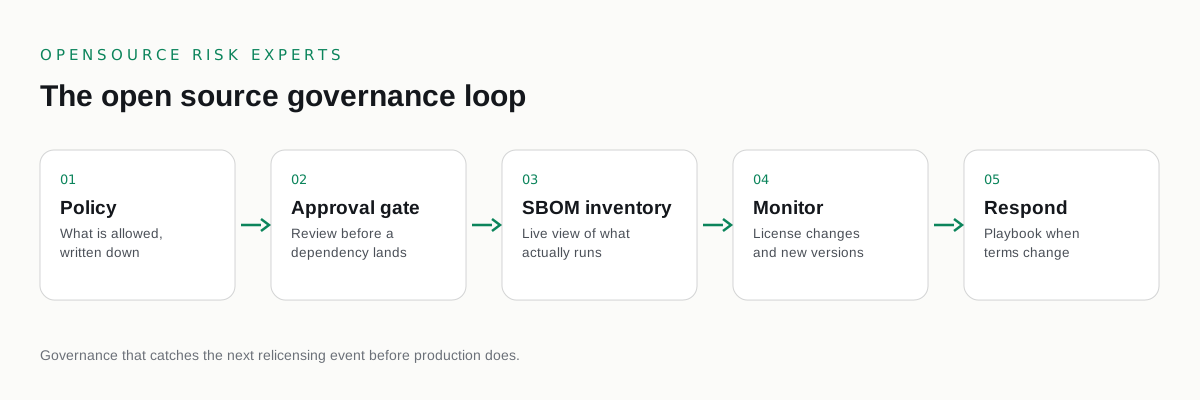
The most useful mental shift is to stop treating AI generated code as a special case and start treating it as another dependency that must pass intake. You would not ship a third party library without recording its license. Generated code deserves the same discipline. It enters your codebase, it may carry an obligation, and it must therefore clear the same checks. This reframing turns an unfamiliar problem into a familiar one, and lets you apply controls you may already have rather than inventing a separate regime. The goal is one intake process that covers every way code arrives, whether written, imported, or generated.
How to govern it
Four controls cover most of the risk. Set a clear policy on assistant use that states what is permitted and what must be reviewed. Scan generated code for similarity to known licensed source, using tools designed to detect reproduced snippets, so a close match is flagged rather than merged silently. Record provenance wherever the assistant or workflow can supply it, so the origin is documented at the moment of creation rather than reconstructed later. And route uncertain cases to human review, so a flagged snippet gets a decision instead of a default acceptance. None of this slows good development much, because most generated code is fine, and the controls only bite on the cases that actually carry risk. Wiring these checks into existing developer workflows is what keeps them from being ignored, which is the focus of open source approval workflows for developers.
Record it in the same inventory
Provenance information is only useful if it is kept somewhere you can find it. The natural home is the same software bill of materials that already records your dependencies. Capturing where code came from, including a note that a section was generated and the result of any similarity scan, keeps the whole picture in one place. When an auditor or an acquirer asks what is in your software and under what terms, a single current inventory that includes generated code answers the question. Automating that inventory is the practical foundation, covered in open source inventory automation.
The buyer side view
We help you extend your governance to cover code from coding assistants without building a parallel bureaucracy. We set the policy, fold generated code into your intake and your inventory, and define when a flagged snippet goes to review. We are paid only by you, so the controls reflect your risk tolerance rather than a tool vendor's marketing. Questions about copyright and infringement for AI generated code are legal questions, and we work alongside your own counsel rather than in place of it.
COMMON QUESTIONS
Questions buyers ask.
What is AI generated code and license provenance risk?
AI generated code and license provenance risk is the exposure that arises when code produced by a coding assistant resembles or reproduces licensed source, and you cannot trace where it came from. Without provenance, you cannot confirm that the code carries no copyleft or attribution obligation.
Why is provenance hard to establish for AI generated code?
Coding assistants are trained on large bodies of source under many licenses, and the generated output does not come with a record of its origin. A snippet may be original, or it may closely match licensed code, and the developer accepting it usually has no way to tell which.
How does this connect to open source license risk?
It is the same problem as a relicensed dependency, arriving by a new door. In both cases an obligation can enter your codebase without being recorded. If generated code reproduces copyleft source, you may carry a copyleft obligation you never chose, just as a relicense can impose terms on code already running.
How do you govern AI generated code?
Set a policy on assistant use, scan generated code for similarity to known licensed source, record provenance where you can, and route uncertain cases to review. Treat AI output as another dependency that must pass intake, not as code that bypasses the controls applied to everything else.
Is this article legal advice?
No. It is commercial and licensing risk analysis, not legal advice. Questions about copyright, infringement, and license obligations for AI generated code belong with your own counsel.
CONTAINMENT
Govern provenance before it becomes a finding.
Confidential open source governance and policy support. Independent, buyer side, paid only by you.
Not ready to talk? Read the free open source license risk guides first.
One email when a major project relicenses. No marketing, unsubscribe any time.
MORE IN THIS CLUSTER