HASHICORP AND TERRAFORM
Terraform vs OpenTofu: the migration decision.
BY FREDRIK FILIPSSON · REVIEWED BY MORTEN ANDERSEN
After the Business Source License change, every Terraform shop faces the same question. The Terraform to OpenTofu migration decision is a weighing of license exposure against the cost of moving, and it is best made with both sides measured.
Commercial and licensing risk advisory, not legal advice.
The Terraform to OpenTofu migration decision is not a question of which tool is better in the abstract. Both descend from the same codebase, and for many estates they behave nearly identically. The decision is a risk and cost calculation: how much license exposure does staying on Terraform under the Business Source License create for you, and how much effort and risk does moving to OpenTofu involve. Get those two quantities on the table and the choice usually becomes clear. The mistake is to decide on instinct, either rushing to migrate out of unease or staying put out of inertia, without measuring either side. This article sets out how to weigh them.
For the background on the change itself, see HashiCorp BSL: what changed and what it means, and the full cluster lives on the pillar for HashiCorp and Terraform license risk.
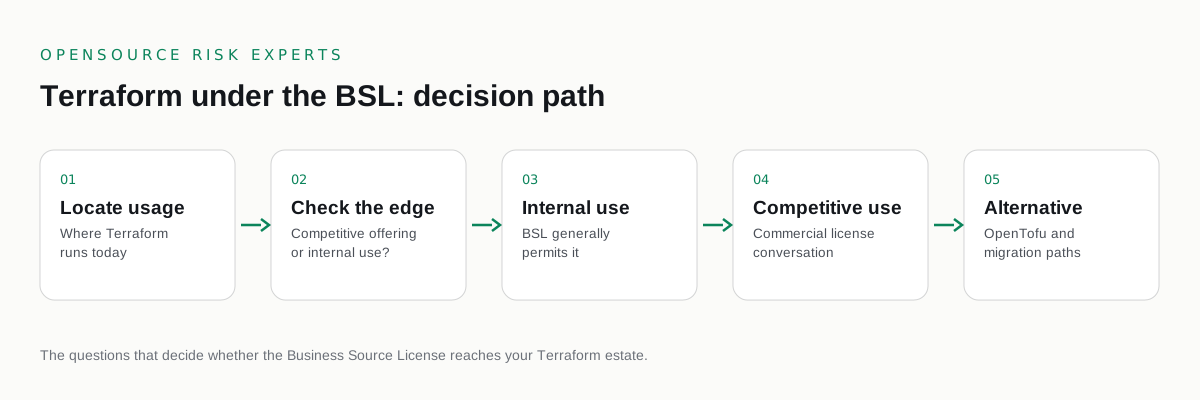
Weigh your license exposure first
Start on the exposure side. HashiCorp moved Terraform to the Business Source License as of August 2023, and that license restricts competitive production use. For most enterprises that simply provision their own infrastructure, the restriction does not bite, because they are not offering a competing product. But the analysis is not always that simple. If you embed Terraform in a product, offer provisioning as a service, or operate in a way that could be read as competitive, the exposure is real and the migration case strengthens. The first task is therefore to read the Business Source License against your actual use, a judgment explored in is your Terraform use competitive under the BSL. Where the answer is uncertain, that uncertainty itself is a cost, because it must be managed, documented, and revisited as your business changes.
Exposure also scales with the size of your estate. The more teams running Terraform, the more places the question has to be answered, as covered in assessing Terraform exposure across teams.
Weigh the cost and risk of moving
On the other side sits the cost of migrating to OpenTofu. Because OpenTofu began as a fork of Terraform built for compatibility, the cost is often lower than teams fear, particularly for versions near the fork point. But it is not zero. The work scales with your Terraform version, the breadth of providers and modules you depend on, and the complexity of your pipelines. An estate on a recent Terraform release that has diverged from the fork will need more verification than one on an older version. The migration risk is mostly in state handling and provider compatibility, both manageable with a staged approach. The practical mechanics are set out in migrating from Terraform to OpenTofu step by step. Estimate this cost honestly, because an overstated migration cost can keep you carrying exposure you did not need to, and an understated one can turn a clean migration into a rushed one.
Consider the long term position of each path
Beyond the immediate weighing, consider where each path leads. Staying on Terraform keeps you on a mature, vendor backed tool, but under a license whose restrictions could matter more if your business model shifts toward anything competitive, and under a vendor now owned by IBM following its acquisition of HashiCorp. Moving to OpenTofu places you on a community fork under an open license, backed by a foundation, with the Business Source License exposure removed. The open question for OpenTofu is sustained compatibility with the providers and modules your estate relies on as both projects evolve independently. Neither path is risk free. The honest framing is that you are choosing which risk you would rather hold: license exposure on a vendor tool, or compatibility and ecosystem risk on a fork.
For many enterprises the deciding factor is the value they place on an openly licensed provisioning layer as a matter of policy, independent of whether today's use is competitive.
Making the call
With both sides measured, the decision usually resolves into one of three outcomes. If your use could be read as competitive, or you want an openly licensed path as policy, and migration cost is moderate, OpenTofu is the lower exposure choice and the case to move is strong. If your use is clearly permitted, your estate is large and recent, and migration cost is high, staying on Terraform and documenting your position may be reasonable for now, provided you revisit it as the business changes. And many estates land in the middle, migrating the parts where exposure is real and cost is low while leaving the rest under review. The Terraform to OpenTofu migration decision rewards the team that measures both sides rather than the one that reacts. This article is commercial and licensing risk advisory, not legal advice. For interpretation of the Business Source License against your use, your own counsel is the right place to turn.
Whichever way the decision goes, record the reasoning. A documented choice, with the exposure and cost both shown, is what makes the position defensible to a board, an auditor, or an acquirer later.
COMMON QUESTIONS
Questions buyers ask.
How do you make the Terraform to OpenTofu migration decision?
The Terraform to OpenTofu migration decision weighs your license exposure under the Business Source License against the cost and risk of moving. If your use could be read as competitive, or you simply want an openly licensed path, OpenTofu is the lower exposure choice. If your use is clearly permitted and migration cost is high, staying may be reasonable for now.
Why did Terraform move to the Business Source License?
HashiCorp moved Terraform, Vault, Consul, Nomad, and Packer to the Business Source License as of August 2023 to restrict competitive production use. IBM later acquired HashiCorp. OpenTofu was created as a community fork to keep an openly licensed version available.
Is OpenTofu a safe long term choice?
OpenTofu is a community fork maintained under an open license and backed by a foundation. For teams that value an openly licensed provisioning path, it removes the Business Source License exposure. Its long term fit depends on continued compatibility with the providers and modules your estate relies on.
What does it cost to migrate from Terraform to OpenTofu?
Cost depends on your Terraform version, the size of your estate, and how far the two tools have diverged. For versions near the fork point the work is often modest, but a large estate on a recent Terraform release should expect verification effort across providers, modules, and pipelines.
Is this legal advice?
No. This article is commercial and licensing risk advisory, not legal advice. For interpretation of the Business Source License against your use, we recommend your own counsel.
SEE YOUR EXPOSURE
Measure both sides before you decide.
A confidential relicensing exposure review. Independent, buyer side, paid only by you.
Not ready to talk? Read the free open source license risk guides first.
One email when a major project relicenses. No marketing, unsubscribe any time.
MORE IN THIS CLUSTER