ARTICLE . UPDATED JUNE 2026
Leverage in Open Source Commercial Negotiations
BY MORTEN ANDERSEN · REVIEWED BY FREDRIK FILIPSSON
Leverage in open source commercial negotiations is not bluster. It is the buyer's real ability to pay less or walk away without losing what matters. It is built from three things you control before the call: measured usage, a credible alternative, and timing. When a relicense forces a commercial conversation, these are what move the price.
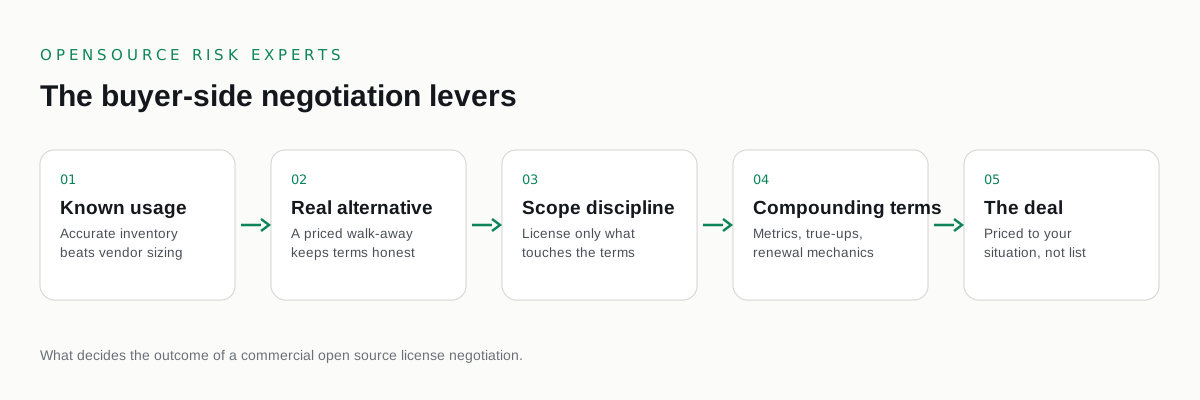
A vendor that has relicensed holds an obvious advantage. The software is already in your production systems, the switching cost is real, and the timing is often theirs to set. But that advantage is not absolute. It rests on assumptions about what you run and what you can do instead, and every one of those assumptions can be tested. The buyers who pay the most are the ones who never test them. The buyers who pay a fair price arrive having already measured their usage, valued their alternatives, and removed any artificial deadline, so the vendor is negotiating against facts rather than fears.
Measured usage is the foundation of leverage
The first lever is knowing exactly what you run. Vendors price from tiers and assumptions, and in the absence of the buyer's own numbers, those assumptions set the baseline. A precise inventory, how many instances, at what scale, with which features actually in use, lets you negotiate against reality and reject tiering that does not fit your footprint. This matters across the relicensing wave. As of August 2023, HashiCorp moved Terraform, Vault, Consul, Nomad, and Packer to the Business Source License 1.1. Redis moved to a dual model with the Server Side Public License as of March 2024. Elasticsearch and Kibana moved to the Server Side Public License and the Elastic License as of 2021. In each case, the buyer who can state usage exactly holds the advantage. An open source license risk assessment produces that usage baseline.
A credible alternative changes the conversation
The second lever is somewhere else to go. Community forks such as OpenTofu for Terraform, Valkey for Redis, and OpenSearch for Elasticsearch give buyers a genuine alternative to paying. What matters is credibility, not the threat. A buyer who has scoped the migration, costed it, and is prepared to make it holds real power. A buyer who only mentions the fork as a bargaining line holds none, because vendors can tell the difference. Valuing the alternative honestly before the negotiation is what turns it into leverage. We work through one such decision in negotiating a Redis Enterprise license.
Timing is leverage you give away by waiting
The third lever is the clock. Leverage is highest before a vendor letter arrives, because you can still choose your pace. Once an inquiry sets a deadline, the conversation moves to the vendor's timeline and every option you have not already prepared becomes harder to use. Mapping exposure and valuing alternatives early is therefore worth more than almost any single concession won under pressure later. The buyer who acts before the trigger negotiates on their own clock. The one who waits negotiates on the vendor's. This is why the cost to act rises with delay, a dynamic we examine in the cost to cure open source license risk.
Combining the levers into a position
The three levers compound. Measured usage tells you the price your footprint justifies. A costed alternative tells you the ceiling beyond which paying makes no sense. Controlled timing lets you hold to both without being rushed past them. Together they define a narrow band the agreement should land inside, and most opening offers sit well above it. The discipline is to enter the negotiation with all three prepared and to decline to move outside the band the facts support. The mistakes that squander this position are predictable, and we catalogue them in commercial open source negotiation mistakes. The full discipline sits on the commercial licensing pillar.
How independence reinforces leverage
We sit only on the buyer side. We take no vendor fees and resell no software, so the usage baseline, the valuation of the alternative, and the target price reflect your interests and nothing else. That independence is itself a form of leverage, because the figures you bring to the table are not shaded by a reseller margin or a referral relationship. Where the honest answer is that the commercial license is fair, we will tell you. Where it is not, we will tell you that too. This is commercial and licensing risk advisory, not legal advice. For interpretation of specific license terms and your compliance position, engage your own counsel.
COMMON QUESTIONS
Questions buyers ask.
What is leverage in an open source commercial negotiation?
Leverage is the buyer's ability to walk away or pay less without losing what matters. It comes from knowing your real usage, holding a credible alternative such as a community fork, and controlling the timing rather than negotiating under a deadline the vendor set.
Why does measured usage create leverage?
Vendors price from assumptions when the buyer has no figures. A precise inventory of what you run lets you negotiate against reality and reject tiering that does not match your footprint, which almost always lowers the defensible price.
How does a fork strengthen a negotiation?
A costed, genuinely viable move to a fork such as OpenTofu, Valkey, or OpenSearch gives the buyer a real alternative to paying. The credibility of that alternative, not the threat of it, is what shifts the price.
Does timing affect leverage?
Strongly. Leverage is highest before a vendor letter forces a deadline. Mapping exposure and valuing alternatives early means you negotiate on your clock, not the vendor's, which is often worth more than any single concession.
Is this legal advice?
No. This is commercial and licensing risk advisory, not legal advice. For interpretation of license terms and compliance questions, we recommend you engage your own counsel.
CONTAINMENT
Build your leverage before the call.
Buyer side commercial license negotiation. Independent, paid only by you.
Not ready to talk? Read the free open source license risk guides first.
One email when a major project relicenses. No marketing, unsubscribe any time.
MORE IN THIS CLUSTER