COMMERCIAL LICENSING
Negotiating a MongoDB commercial license.
BY FREDRIK FILIPSSON · REVIEWED BY MORTEN ANDERSEN
When the Server Side Public License puts your MongoDB usage in question, a commercial license is often the answer. This article covers negotiating a MongoDB commercial license: where the leverage sits, which terms matter, and how to price the deal to your actual usage.
Commercial and licensing risk advisory, not legal advice.
Negotiating a MongoDB commercial license starts with understanding why the conversation exists at all. MongoDB moved to the Server Side Public License in 2018, the earliest of the major source available shifts. The Server Side Public License is not an OSI approved open source license, and it carries copyleft style conditions aimed at parties that offer the database as a managed service to others. For many organizations the practical question is whether their usage sits comfortably inside the free terms or whether a commercial license is the cleaner way to keep things clear. When the answer points to a commercial license, the negotiation becomes the next exposure to manage.
The principle is the same one that governs every commercial open source deal: the list price is built for someone else, and your job is to land terms that reflect your situation. The broader playbook for that work sits in the pillar on open source commercial licensing.
Why negotiating a MongoDB commercial license is on the table
The Server Side Public License changed the calculus for organizations that had treated MongoDB as freely usable. Its condition reaches parties that make the functionality of the database available to third parties as a service, and the precise edge of that condition is a question for counsel rather than a settled fact. What is clear is that the uncertainty itself has value to the vendor, because the cleanest way to remove it is a commercial agreement. That is the lever the negotiation turns on, and recognizing it is the first step to negotiating from a position of clarity rather than worry.
It helps to know this is not a MongoDB specific dynamic. The same shape recurs across the source available wave, which is why the patterns from a HashiCorp deal carry over directly. The mechanics of one of those conversations are walked through in negotiating a HashiCorp commercial license.
Know your usage before you take the call
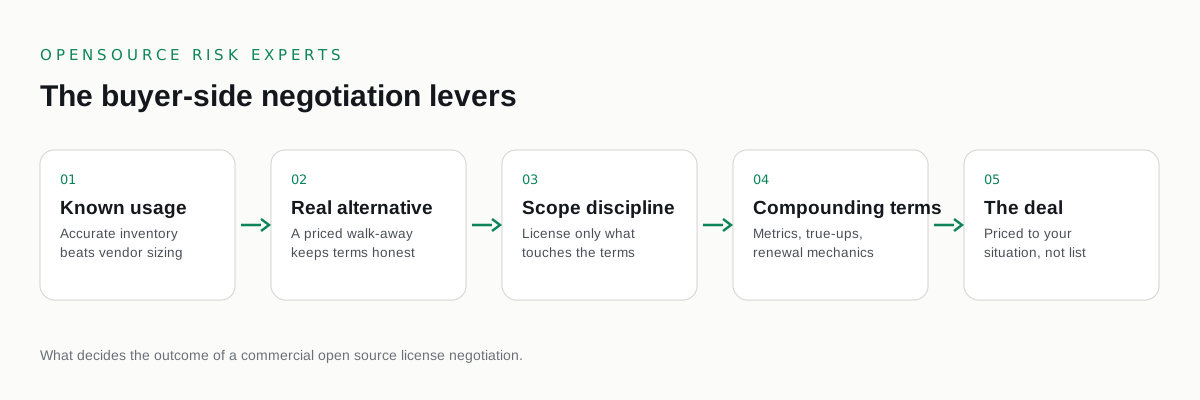
Your strongest asset in the negotiation is an accurate picture of what you actually run. How many clusters, what data volumes, which environments, and crucially whether your usage even touches the condition that drives the deal. A vendor sizing a quote will tend toward the larger interpretation of your footprint. The buyer who arrives with a precise inventory can challenge that figure with facts, and can separate the usage that genuinely needs a commercial license from the usage that does not. Walking in without that picture means accepting the vendor's version of your own deployment, which is rarely the cheaper one.
This is also where an independent, buyer side view earns its place. The point of the inventory is not to minimize what you disclose but to be certain of it, so that the negotiation rests on a shared and accurate baseline rather than a vendor estimate. The discipline of holding that line is covered in leverage in open source commercial negotiations.
Keep a credible alternative on the table
A negotiation with no walk away option is not a negotiation. For MongoDB, the alternatives are real: document compatible databases and managed services exist, and migrating to one is a known quantity even if it is not free. You do not have to intend to leave for the alternative to matter. Its existence, priced and understood, is what keeps the commercial terms honest, because the vendor knows the deal has to beat the cost of you walking. Pricing that alternative before you negotiate, rather than scrambling for it afterward, is what makes the leverage credible rather than rhetorical.
The comparison should be honest in both directions. Migration carries real engineering cost and real risk, and a clear eyed view of that cost is what tells you how much the alternative is actually worth as leverage. Overstating it fools no one; understating it leaves value on the table.
Watch the terms that compound over time
The headline price is the part everyone reads. The terms that decide what the deal costs over its life are usually further down. Watch the usage metric and how it scales, because a price that looks fair today can climb fast under a metric tied to something you expect to grow. Watch the audit and true up clauses, which determine what happens when your usage moves. Watch the renewal mechanics, where the leverage you hold at signing can quietly disappear at renewal if the agreement does not protect it. A deal optimized only for the first year price often pays for that saving many times over later.
Negotiating a MongoDB commercial license is winnable when you know your usage, hold a credible alternative, and read past the headline to the terms that compound. The buyers who do well are the ones who treated it as a deal to be shaped rather than a price to be accepted. This article is commercial and licensing risk advisory, not legal advice. For interpretation of the Server Side Public License or any specific commercial agreement, your own counsel is the right place to turn.
COMMON QUESTIONS
Questions buyers ask.
Why does negotiating a MongoDB commercial license come up at all?
MongoDB moved to the Server Side Public License in 2018. The SSPL is not an OSI approved open source license and carries copyleft style conditions aimed at parties that offer the database as a service, which leads many organizations to a commercial license to keep their usage clear.
What leverage do we have in a MongoDB negotiation?
Your leverage is an accurate picture of your own usage and the existence of credible alternatives. Knowing exactly what you run, and that a community compatible database or a managed alternative exists, changes the conversation from list price to a deal that reflects your situation.
Should we consider an alternative to a MongoDB commercial license?
It is worth pricing. Document compatible databases and managed services give you a walk away option, and even if you stay, the credible alternative is what keeps the commercial terms honest. The comparison should be run before you negotiate, not after.
What terms matter most in a MongoDB commercial license?
Watch the usage metric and how it scales, audit and true up clauses, the renewal mechanics, and any limits on deployment. A price that looks reasonable today can grow quickly under a metric that tracks something you expect to expand.
Is this legal advice?
No. This article is commercial and licensing risk advisory, not legal advice. For interpretation of the SSPL or a specific commercial agreement, we recommend your own counsel.
NEGOTIATE FROM STRENGTH
Negotiate the license from your side of the table.
Buyer side commercial license negotiation. Independent, buyer side, paid only by you.
Not ready to talk? Read the free open source license risk guides first.
One email when a major project relicenses. No marketing, unsubscribe any time.
MORE IN THIS CLUSTER