PILLAR GUIDE
Commercial Open Source Licensing: The Complete Negotiation Guide
Commercial open source licensing is the paid path a vendor offers when its public license no longer covers your use. This guide explains when a commercial license becomes necessary, how open core pricing is built, and how to negotiate the terms from your side of the table. We write as an independent advisory, paid only by the buyer.
For years, the enterprise treated open source as free in both senses: free to use and free of obligation. The relicensing wave ended that assumption. A project a company had run for a decade could move to terms that reserve competitive production use for a paid agreement, and the only way to keep running it unchanged was to buy a commercial license. Commercial open source licensing is the discipline of handling that moment well, from the day the change lands to the day you sign or walk away.
This pillar is the hub for everything we publish on the topic. It sets out the landscape, then links to the detailed pieces on when you must buy, how to avoid overcommitting, and what obligations a commercial license carries after signing. Throughout, one principle holds. A commercial license is a negotiation, not a tax. The list price is a starting point built for an average buyer who is not you.
What commercial open source licensing means
A commercial open source license is the paid agreement a vendor sells to grant rights its public license withholds. The same software ships under two regimes. One is the public license, which may be permissive, copyleft, or source available, and which constrains what you can do. The other is the commercial license, which removes those constraints in exchange for a fee and a set of terms. Buyers reach for the commercial path when the public license no longer covers the way they actually run the software.
The phrase causes confusion because open source, in the strict sense, means a license approved by the Open Source Initiative. Several of the projects now sold commercially have moved to licenses that are source available rather than open source. Source available is not open source. The Business Source License and the Server Side Public License are not approved by the Open Source Initiative. We use commercial open source licensing as the working term the market uses, while keeping the distinction clear, because the distinction drives the risk.
Why commercial licenses appear under software you already run
The commercial license rarely appears at adoption. It appears later, when a project relicenses and reserves a use you depend on. The pattern is now well documented. HashiCorp moved Terraform, Vault, Consul, Nomad, and Packer to the Business Source License as of August 2023, restricting competitive production use, with a conversion to an open license after a delay. Redis moved to a model combining the Server Side Public License and the RSALv2 as of March 2024, and later added an open license option. Elasticsearch and Kibana moved from Apache 2.0 to the Server Side Public License and the Elastic License as of 2021, and later added an open license option. MongoDB moved to the Server Side Public License in 2018.
In each case, the change reached software that organizations were already running in production. That is the heart of the exposure. You did not choose a restrictive license. You chose an open one, and the terms moved underneath you. The vendor then offers a commercial license as the way to keep running the software the way you do today. The relicensing pillar covers these events in depth; see the relicensing exposure pillar and the broader open source license risk pillar for the full picture.
The license families you are negotiating against
A negotiation goes better when you know exactly what the public license does and does not permit, because that is the gap the commercial license fills. Four families cover most situations. The Business Source License restricts competitive production use for a period, commonly four years, then converts to an open license. The Server Side Public License extends copyleft to the surrounding service stack, which is why managed service providers are its main target. The GNU AGPL is an approved open source license that extends copyleft to software offered over a network. Open core sits apart: the core is open and the features an enterprise needs are held behind a paid edition.
Each family changes your leverage. Under the Business Source License, the question is whether your use is competitive and whether you can wait for the conversion. Under the Server Side Public License, the question is whether you offer the software as a service to third parties. Under open core, the question is whether you truly need the paid features or have simply assumed you do. Naming the family correctly is the first move, because the vendor will frame the conversation around the answer that sells the most.
When you must buy a commercial open source license
The honest answer is that you must buy less often than vendors imply, and more often than optimistic engineers assume. A purchase becomes necessary when your use clearly falls outside what the current license permits and no alternative path is acceptable. A deployment that counts as competitive production use under the Business Source License is a common trigger. So is a copyleft obligation that conflicts with how you ship a product. Whether a given fact pattern requires a license is a legal question, and we point you to your counsel for it. Our role is to map the use, size the exposure, and prepare the position.
Many buyers discover that what looked like a forced purchase is in fact a choice. Restructuring a deployment, isolating the affected component, or moving to a fork can remove the trigger entirely. We work through that analysis in detail in the article on when you must buy a commercial open source license, which separates the cases where a license is genuinely required from the cases where the vendor would simply prefer one.
How open core pricing works
Commercial open source pricing almost always rests on a usage metric. Nodes, cores, data volume, environments, or seats. The vendor picks the metric that grows fastest with your success, then attaches a list price per unit. The list price is engineered to anchor the conversation high and to make the first discount feel like a concession. It is not a measurement of value to you, and it should not be treated as a fixed cost.
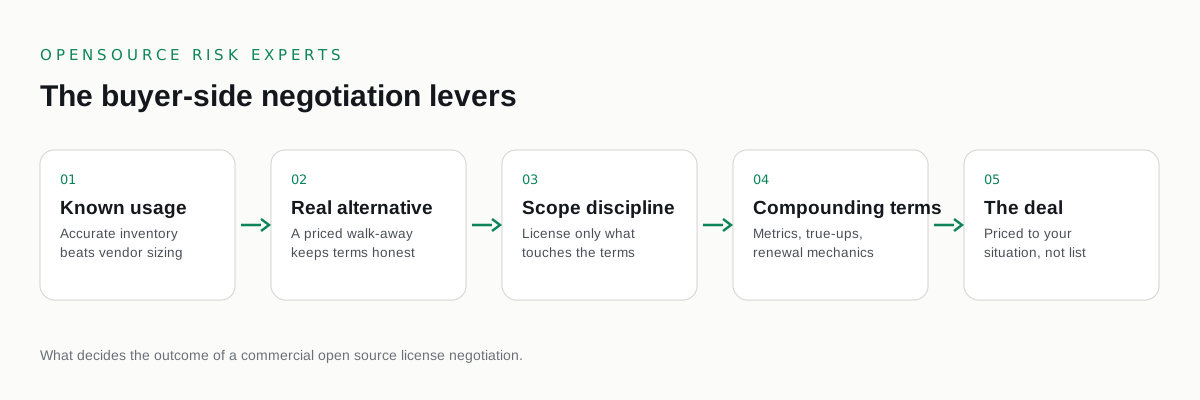
The most expensive mistake is to price on your projected footprint rather than your real one. Vendors encourage a generous estimate because the meter only ratchets up. A disciplined buyer prices on measured usage, caps growth assumptions, and separates the units that genuinely need the commercial license from the units that do not. The difference between a footprint based quote and a usage based one is frequently the largest single saving in the whole negotiation.
Building your negotiation position
Leverage in a commercial open source negotiation comes from two things: a precise usage baseline and a credible alternative. The baseline tells you what you actually consume, so you can refuse to pay for a footprint you do not run. The alternative, a fork, a replacement, or a restructured deployment, gives you somewhere to go if the price stays unreasonable. A buyer with neither pays close to list. A buyer with both pays a fraction of it.
Timing matters as much as data. The strongest position is built before the renewal clock forces a decision, while there is room to walk. The weakest is assembled in the final week, when production is running and the vendor knows it. We help buyers prepare the baseline and the walk away path early, then negotiate the terms from the buyer side through our open source commercial license negotiation service. The agreement that results reflects your usage and your leverage rather than a list built for someone else.
Avoiding overcommitment
A commercial license can solve today's problem and create tomorrow's. Multi year terms, automatic uplifts, and minimum commitments lock in a spend that assumes your usage only grows. If your footprint shrinks, or you migrate part of it off the product, you keep paying for capacity you no longer use. The vendor is happy to sell a larger, longer deal. The buyer's interest is the smallest commitment that covers the genuine need with room to adjust.
The defenses are structural. Shorter terms, the right to true down as well as up, caps on annual increases, and a clean exit at renewal all protect against a footprint that changes. We cover these mechanisms in the article on avoiding overcommitment on a commercial license, which shows how a deal sized for flexibility costs less over its life than a deal sized for a headline discount.
Compliance after signing
Signing the agreement is not the end of the obligation. Commercial licenses carry usage reporting, audit rights, deployment restrictions, and renewal mechanics that the buyer must manage for the life of the deal. A team that loses track of its own usage can drift into a breach without noticing, then face a true up bill at audit. The agreement that protected you at signing only keeps protecting you if someone owns it afterward.
We set out the ongoing duties in the article on commercial license compliance obligations. The short version is that a commercial license should be governed like any other material contract, with a named owner, a usage record kept current, and a calendar that surfaces the renewal before the vendor does.
Alternatives to buying
A commercial license is one option among several, not the only one. The relicensing wave produced credible community forks: OpenTofu for Terraform, Valkey for Redis, and OpenSearch for Elasticsearch. Each preserves an open license posture and can remove the need to pay, provided its governance and momentum fit your needs. Replacing the component with a different tool resets the license risk at the cost of migration. Restructuring how you deploy can sometimes move you outside the restricted use entirely.
The point is not that an alternative is always better. It is that a buyer who has costed the alternatives negotiates from strength, and a buyer who has not negotiates from fear. We weigh these paths in the remediation and alternatives pillar and execute the chosen one through open source remediation advisory. Even when buying is the right answer, holding a real alternative is what makes the price reasonable.
A commercial open source licensing checklist
Before you respond to a vendor quote, confirm five things. First, the exact license family and the specific use it restricts. Second, whether your use genuinely falls inside that restriction, a question for your counsel. Third, your measured usage baseline, separated from your projected footprint. Fourth, a costed alternative you would be willing to execute. Fifth, the renewal and audit mechanics you will be agreeing to, not just the headline price. A buyer who can answer all five negotiates a fair deal. A buyer who can answer none signs the first number offered.
None of this is legal advice. We provide commercial and licensing risk advisory, and we point you to your own counsel for interpretation of license terms and for the question of whether a license is required. What we add is the buyer side discipline that turns a vendor framed purchase into a negotiated agreement you can defend to your board.