ARTICLE / COMMERCIAL LICENSING
Negotiating a HashiCorp commercial license.
BY MORTEN ANDERSEN · REVIEWED BY FREDRIK FILIPSSON
Negotiating a HashiCorp commercial license well starts long before the first call with sales. This guide sets out the buyer side approach: confirm your exposure, build a usage baseline, hold a credible alternative, and right size the agreement to what you actually run.
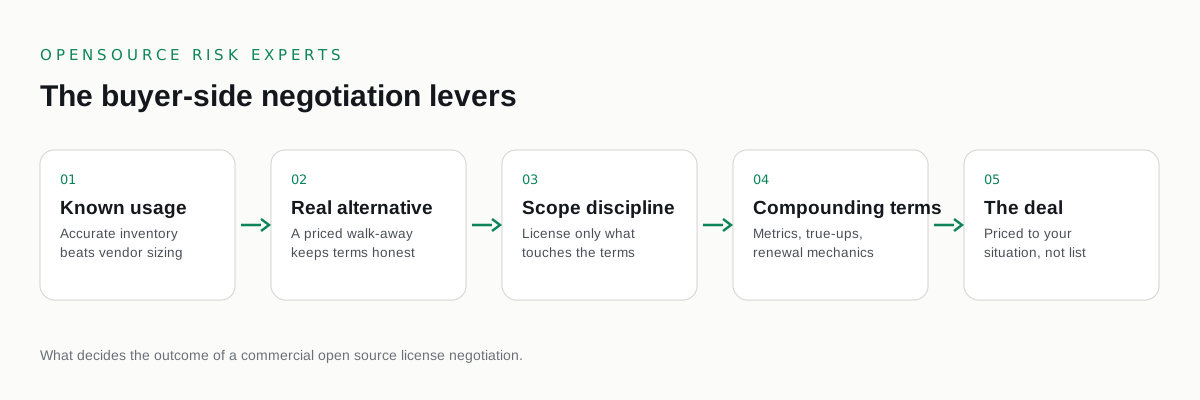
When HashiCorp moved Terraform, Vault, Consul, Nomad, and Packer to the Business Source License as of August 2023, a class of production use that used to be free became something a vendor could charge for. For many enterprises the eventual answer is a commercial license. The difference between a fair agreement and an expensive one is rarely the list price. It is the preparation the buyer brings. Negotiating a HashiCorp commercial license is a buyer side discipline, and the leverage is built before the conversation starts, not improvised inside it.
Start negotiating a HashiCorp commercial license by confirming exposure
The first move is to confirm that you actually need to pay. The Business Source License restricts competitive production use and converts to an open license after a delay, commonly four years. Not every internal use falls inside the restriction. Before opening a commercial conversation, establish where your Terraform and other HashiCorp use sits relative to that restriction, because a buyer who does not know whether they are in scope negotiates from fear rather than fact. Whether your specific use is restricted is a question for your own counsel, and that answer sets the floor for everything that follows. We cover the threshold question in is your Terraform use competitive under the BSL.
Build a usage baseline the vendor cannot inflate
A commercial license is priced on scope, and scope is where buyers lose money. If the vendor sets the count, the count tends to run high. Build your own usage baseline first: how many workspaces, nodes, or users genuinely require a licensed edition, separated from the use that stays within the open terms or that you intend to migrate away. An accurate baseline is the single most valuable artifact in the negotiation, because it lets you contest an inflated estimate with evidence and pay for what you truly run rather than a generous round number. The baseline also becomes the reference for the next renewal, so it keeps paying back long after the first deal closes.
Keep OpenTofu as a live alternative
Leverage in any license negotiation comes from a credible alternative, and for Terraform that alternative is OpenTofu, the community fork that continues the project under an open license. A buyer who has assessed OpenTofu compatibility against real workloads negotiates differently from one who has not, because the option to walk is real rather than rhetorical. You do not have to intend to fork to benefit from the option. Keeping it live and tested shifts the balance of the conversation and caps how far a price can climb. We weigh the fork against paying in when you must license HashiCorp commercially.
Time the negotiation and the term
Timing is leverage. A negotiation conducted under a forced renewal deadline favors the vendor, so the work to confirm exposure and build the baseline should run well ahead of any cliff. The term itself is a lever too. A longer commitment can buy a better rate and protection from increases, but it also deepens lock in, so the right term depends on how confident you are in your usage forecast and your alternatives. The trade between price certainty and flexibility is the heart of the structure, and we examine it across vendors in our pillar on commercial licensing. Renewal leverage specifically is covered in HashiCorp renewal and negotiation leverage.
Account for the IBM acquisition
IBM acquired HashiCorp, and over time that can change who owns your account, how products are bundled, and how renewals are framed. As of 2026 the practical step for a buyer is to confirm who holds the relationship and whether wider enterprise agreements or IBM terms are now in play, then keep the negotiation anchored to your usage baseline rather than a packaged proposal. A larger vendor on the other side of the table is a reason to be more precise about scope, not less. The agreement should still reflect what you run and the leverage you hold, and the interpretation of any contract language remains a matter for your own counsel.
COMMON QUESTIONS
Questions buyers ask.
When do I need to negotiate a HashiCorp commercial license?
You may need a commercial license when your use of Terraform, Vault, Consul, Nomad, or Packer falls inside the competitive restriction of the Business Source License, which HashiCorp adopted as of August 2023, and forking to OpenTofu or migrating is not viable on your timeline. The first step is to confirm whether your use is actually restricted, which is a question for your own counsel.
What gives a buyer leverage in a HashiCorp negotiation?
Leverage comes from a credible alternative and an accurate usage baseline. OpenTofu, the community fork of Terraform, is a real option that changes the conversation. A precise picture of what you run, rather than the vendor estimate, prevents being priced on inflated scope. Timing the negotiation away from a forced renewal also helps.
How does the IBM acquisition affect the negotiation?
IBM acquired HashiCorp, which can change account ownership, bundling, and renewal posture over time. As of 2026 the practical effect for a buyer is to confirm who holds the relationship and whether enterprise agreements or wider IBM terms are in play, then negotiate on your usage rather than a packaged list price.
Should I fork to OpenTofu instead of paying?
Sometimes. OpenTofu is the open license fork of Terraform and can remove the restriction outright where compatibility holds. Whether forking beats paying depends on your engineering cost, timeline, and how deeply Terraform is embedded. The strongest negotiations keep the fork as a live option even when paying is the likely outcome.
Is HashiCorp license negotiation legal advice?
No. This is commercial and licensing risk advisory, not legal advice. For interpretation of whether the Business Source License restricts your specific use, and for contract terms, we recommend your own counsel.
COMMERCIAL LICENSING
Negotiate from your side of the table.
Our negotiation advisory builds your usage baseline and leverage before the first call. Independent, buyer side, paid only by you.
Not ready to talk? Read the free open source license risk guides first.
One email when a major project relicenses. No marketing, unsubscribe any time.
MORE IN THIS CLUSTER