ARTICLE / UPDATED JUNE 17 2026
Open Core Pricing Models Explained
BY FREDRIK FILIPSSON · REVIEWED BY MORTEN ANDERSEN
Open core pricing models explained for the buyer who has to fund them. This article sets out how vendors split free and paid, the levers that drive the bill, and how to read the model before you sign.
Open core is the most common commercial model in the open source world, and understanding open core pricing is the first step to paying a fair price for it. The shape is simple: a free, open base draws in users, and a paid edge of proprietary features, support, and hosting captures revenue from the ones who need more. The complexity, and the cost, live in where the line between free and paid is drawn and in how the paid side is metered. This article explains how those pricing models work so you can read a vendor's offer for what it is rather than for how it is presented.
The article sits under the pillar on commercial licensing and feeds directly into open source commercial license negotiation, where the model becomes the thing you negotiate against. For the underlying definition, see the glossary entry on open core.
How the free and paid split is drawn
The defining choice in any open core model is what stays free and what moves behind the paywall. Vendors keep the base broadly capable so it earns real adoption, then place the features that large organizations cannot do without on the paid side. Those features cluster in predictable areas: advanced security and access control, high availability and clustering at scale, compliance and audit tooling, management consoles, and enterprise support. The pattern is deliberate. The free base proves the value, and the enterprise edge is exactly the set of things an enterprise will eventually need.
For a buyer, the first task is to map your real requirements against this split. Some organizations need only the open base and never cross the line. Others assume they need the enterprise tier when a careful look shows that one or two paid features are the actual driver. Knowing precisely which paid features you depend on, and which you could live without, turns a take it or leave it tier into a set of line items you can question.
The levers that drive the bill
Open core pricing rests on a handful of levers, and the one that matters most is the usage metric. A model can meter on nodes, cores, data volume, requests, seats, or some blend. The headline rate is easy to compare across vendors, but the metric decides how your bill grows over time. A price tied to data volume in a system whose data grows quickly will rise far faster than the rate alone suggests. The metric, not the rate, is where future cost is decided.
The other levers are the feature tier, the support level, and the deployment model. Tiers bundle features in ways that often force you to buy a higher band for a single capability. Support levels carry their own multipliers. Deployment choice, self managed against vendor hosted, changes both the price and what you are responsible for. Reading these levers together, rather than fixating on the headline number, is what tells you whether a quote reflects your usage or a profile built for a much larger customer. The benchmarks in commercial open source pricing benchmarks give a reference point for what a fair rate looks like.
Open core is not the same as a relicense
It is worth separating open core from a source available relicense, because buyers often conflate them. In open core, the base stays open and you choose whether to buy the edge. In a relicense, the license of the core itself changes. When HashiCorp moved Terraform, Vault, Consul, Nomad, and Packer to the Business Source License as of August 2023, or when Redis moved to the Redis Source Available License and the Server Side Public License as of March 2024, the component you already ran changed terms beneath you. That is a different problem, because the open option you relied on is gone, and the community response was a fork: OpenTofu, Valkey, and OpenSearch respectively.
The distinction matters for leverage. With pure open core, the open base remains a genuine alternative, which strengthens your position when you negotiate the edge. After a relicense, the calculus shifts toward whether a fork or an alternative can carry the load, and the commercial license becomes one option among several rather than the only road forward. Knowing which situation you are in keeps the conversation honest.
The headline rate is the part of an open core quote a vendor wants you to compare. The pricing metric is the part that decides what you actually pay over three years. Read the metric first.
How a buyer should read the model
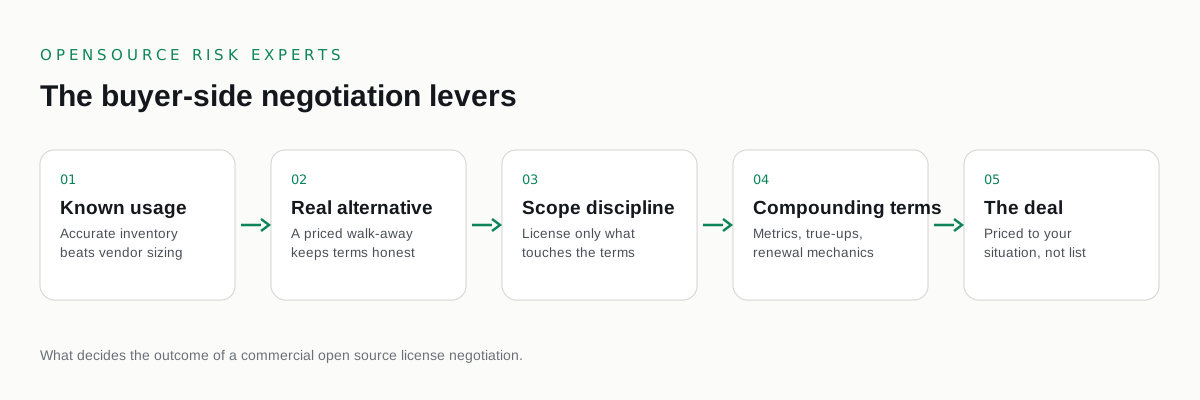
A disciplined evaluation comes down to three questions. Which paid features do you genuinely need, and could the open base or a fork meet the requirement instead? How does the pricing metric scale against your roadmap over the next three years, not just today? And where is your leverage, whether that is a credible alternative, a renewal date, or a usage baseline the vendor does not yet know you have? Answering these turns a glossy tier sheet into a negotiation you can win on facts.
The aim throughout is to pay for the value you use, not for a package designed around someone else's usage. When a commercial license is the right answer, the next step is to negotiate it from your side of the table, covered in when you must buy a commercial open source license and leverage in open source commercial negotiations. Understanding the pricing model is what makes that negotiation possible.
RELATED READING
COMMON QUESTIONS
Questions buyers ask.
What is open core and how does its pricing work?
Open core is a model where a free, open base is surrounded by paid proprietary features, support, or hosting. Pricing usually keys off a usage metric such as nodes, data volume, or seats, with the most valuable enterprise features placed behind the paywall. The free core anchors adoption and the paid edge captures revenue.
What pricing levers drive an open core bill?
The common levers are the usage metric, the feature tier, the support level, and the deployment model. A metric tied to a fast growing dimension such as data volume can make a bill rise faster than expected, which is why the metric matters as much as the headline rate.
How is open core different from a source available relicense?
Open core keeps an open base and charges for an added edge. A source available relicense, such as a move to the Business Source License or the Server Side Public License, changes the license of the core itself. Both can lead to a commercial bill, but the second removes the open option from the component you already run.
How should a buyer evaluate an open core model?
Map which features you actually need against which sit behind the paywall, check how the pricing metric scales with your roadmap, and test whether the open base alone or a fork could meet the requirement. The goal is to pay for the value you use, not for a tier built around someone else's usage.
Is this legal advice?
No. This is commercial and licensing risk advisory, not legal advice. For interpretation of license terms and compliance questions, engage your own counsel.
NEGOTIATE
Pay for the value you actually use.
Negotiate from your side of the table. Independent, buyer side, paid only by you.
Not ready to talk? Read the free open source license risk guides first.
One email when a major project relicenses. No marketing, unsubscribe any time.
MORE IN THIS CLUSTER