COMMERCIAL LICENSING
Avoiding Overcommitment on a Commercial License
BY MORTEN ANDERSEN · REVIEWED BY FREDRIK FILIPSSON
By OpenSource Risk Experts · June 7, 2026
Avoiding overcommitment on a commercial license is the discipline of buying what you actually use, not what a vendor projects you might use later. When an open source project relicenses and a commercial agreement becomes the path forward, the negotiation that follows is shaped by the vendor, and the vendor's interest is a larger, longer commitment than your present need requires. The buyer who signs to a projected footprint pays for capacity, features, and term length that never get used. This article sets out how overcommitment happens and how a buyer sizes an agreement to measured reality instead.
We write from the buyer side as an independent advisory paid only by the buyer. This is not legal advice. For interpretation of license and contract terms, we point you to your own counsel.
What overcommitment on a commercial license looks like
Overcommitment is paying for more than you use, across any of the dimensions a license is priced on. It shows up as seats bought for an organization larger than the team that runs the software, as capacity sized to a peak you rarely hit, as a feature tier purchased for one capability you need with a dozen you do not, and as a term length that locks you in past the point where your needs might change. Each dimension is a place where a vendor can inflate the deal, and each compounds the others. A license sized to a projected headcount, on a projected capacity, with a full feature bundle, on a five year term, can cost several times what the same usage would cost if each dimension were sized to today.
The reason this matters is not only the immediate cost. An overcommitted license sets a high baseline for every future renewal, because the vendor anchors the next negotiation to what you bought last time. Overpaying once teaches the vendor what you will tolerate, and the inflated number becomes the floor. Sizing correctly the first time protects not just this deal but the ones that follow.
How vendors steer buyers past their real need
The push toward overcommitment usually arrives as a set of reasonable sounding moves. The vendor prices on a projected footprint, presenting your likely growth as the baseline rather than your measured usage. It bundles features, so the capability you need comes only with an enterprise tier full of capabilities you do not. It structures discounts to reward size and length, so the per unit price looks better only if you commit to more volume or a longer term. And it frames the larger deal as the prudent, safe choice, suggesting that buying ahead of need avoids a future scramble. None of these tactics is improper. They are the ordinary mechanics of enterprise sales. But each is designed to move the buyer beyond present need, and a buyer who does not recognize them will drift into a commitment larger than the problem warrants.
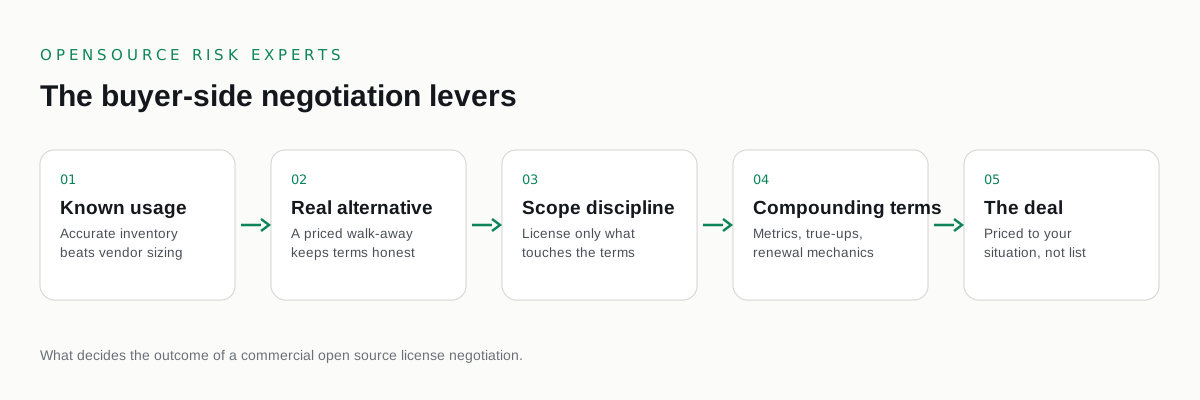
The defense is not suspicion but measurement. A buyer who arrives with a precise account of current usage can meet each tactic with a number. When the vendor prices on projected growth, the buyer prices on the measured baseline and negotiates expansion separately. When the vendor bundles, the buyer asks what the needed feature costs alone. When the discount rewards length, the buyer weighs the price certainty against the lost flexibility rather than accepting the framing. These are the same fundamentals we set out in leverage in open source commercial negotiations.
Sizing the license to measured usage
The antidote to overcommitment is a measured baseline drawn from your own dependency map rather than a vendor estimate. Before any negotiation, establish where the component actually runs, at what scale, used by which teams, and with which features genuinely in use. That baseline becomes the size you buy to. Growth is handled not by buying ahead but by negotiating expansion rights, a fixed or capped price at which you can add capacity when you actually need it. This structure gives you the protection of known future pricing without paying today for capacity you only might use. It also keeps the renewal honest, because the next negotiation starts from what you used rather than what you guessed.
Measured sizing depends on accurate inventory. You cannot buy to real usage if you cannot see it, which is why this discipline sits downstream of a proper assessment of where the relicensed component is deployed. The map that tells you your exposure is the same map that tells you the right size to buy.
Term length and the flexibility trade off
Term length deserves its own attention, because it is where the overcommitment question is most finely balanced. A longer term is not automatically bad for the buyer. After a relicensing event, when future pricing is uncertain and the vendor may raise prices again, locking in a known rate for several years can be genuinely valuable. The risk is not the length itself but committing to volume and scope you may not need for that whole period. The way to capture the benefit without the cost is to separate the two questions. Negotiate a longer term to fix the price, but size the committed volume to current usage and keep expansion flexible. That way you gain price certainty on what you use and avoid being locked into capacity you might not. We weigh this balance in detail in multi year commercial license tradeoffs, and the audit clauses that can quietly enlarge a commitment in commercial license audit clauses to watch.
Sizing an agreement to your real usage and structuring its term and expansion rights from your side of the table is the work of our open source commercial license negotiation service. For the full picture of commercial open source terms, see the commercial open source licensing pillar.
COMMON QUESTIONS
Questions buyers ask.
What does avoiding overcommitment on a commercial license mean?
Avoiding overcommitment on a commercial license means sizing the agreement to your measured, current usage rather than to a vendor's growth projection, so you do not pay for seats, capacity, term length, or features you do not use. The discipline is to buy what you need now with room to expand on fair terms.
How do vendors push buyers to overcommit?
Common tactics are pricing on a projected footprint rather than a measured one, bundling features you do not need, offering discounts that only apply to larger or longer commitments, and framing a multi year deal as the safe choice. Each pushes the buyer to commit beyond present need.
Is a longer term always worse for the buyer?
Not always. A longer term can lock in a good price and protect against future increases, which has value when a project has just relicensed and pricing is uncertain. The risk is committing to volume or scope you may not need. The aim is to capture price certainty without overbuying capacity.
How do I size a license to real usage?
Start from a measured baseline of where the component runs and at what scale, drawn from your dependency map rather than a vendor estimate. Buy to that baseline, negotiate expansion rights at a fixed price for growth, and avoid paying today for capacity you only might need later.
Is this legal advice?
No. We provide commercial and licensing risk advisory, not legal advice. For interpretation of license and contract terms, engage your own counsel.
NEGOTIATION
Buy to what you use, not what they project.
A confidential open source license risk assessment. Independent, buyer side, paid only by you.
Not ready to talk? Read the free open source license risk guides first.
One email when a major project relicenses. No marketing, unsubscribe any time.
MORE IN THIS CLUSTER