COMMERCIAL LICENSING
Commercial License Compliance Obligations
BY FREDRIK FILIPSSON · REVIEWED BY MORTEN ANDERSEN
By OpenSource Risk Experts · June 14, 2026
Commercial license compliance obligations are the duties you take on the moment you sign a paid open source agreement, and they outlast the negotiation by years. Buyers tend to treat the signature as the end of the work. It is closer to the start of a different kind of work. A commercial license does not remove risk, it converts it. The question shifts from whether you are allowed to use the software to whether you are using it within the bounds you agreed to. This article sets out the obligations that commonly appear in these agreements and the practice that keeps a buyer on the right side of them.
We write from the buyer side as an independent advisory paid only by the buyer. This is not legal advice. For interpretation of your specific obligations and contract terms, we point you to your own counsel.
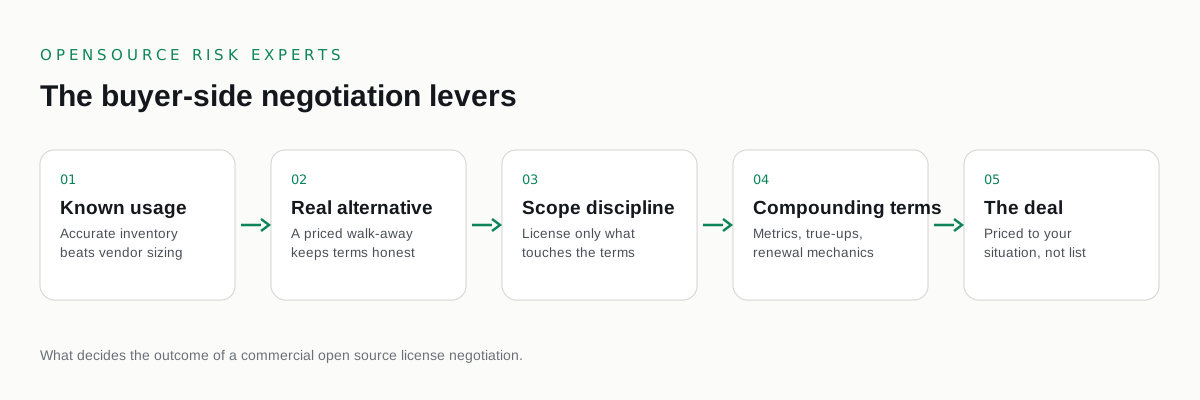
What commercial license compliance obligations cover
Commercial license compliance obligations are the ongoing conditions attached to a paid agreement, distinct from the one time price. They cover usage limits, the defined ceiling on seats, cores, nodes, or environments you are licensed for. They cover scope, the permitted purposes and the deployments excluded from the grant. They cover reporting, the duty to tell the vendor your deployment numbers at set times. They cover audit rights, the vendor's ability to verify your usage. And they cover renewal and true up, the mechanics by which the agreement continues and by which any excess usage is reconciled and paid for. Together these terms define not just what you bought but how you must behave for the life of the deal.
These obligations matter because they are where a compliant buyer can quietly become a non compliant one. Usage grows as teams adopt the software. A deployment spreads to an environment the grant did not cover. A reporting date passes unmet. None of these requires bad faith. They happen through ordinary drift, and the agreement holds you to them regardless of intent. The buyer who understands the obligations at signing is the one who can keep inside them as the deployment evolves.
Usage limits and scope restrictions
The most direct obligation is to stay within the licensed quantity and purpose. A commercial open source agreement licenses a defined amount, measured in whatever unit the vendor prices on, and it permits a defined set of uses. Exceeding the quantity, even unintentionally, puts you out of compliance and exposes you to additional fees. Using the software for a purpose the grant excludes does the same. The risk here is invisibility. A team that spins up new nodes to meet demand, or extends the software into a new product line, may have no idea that it has crossed a line written into a contract it never saw. Keeping inside usage limits therefore depends on the deployment being visible to the people who hold the agreement, which is a governance problem as much as a contractual one.
Reporting, audits, and true up clauses
Most agreements give the vendor a way to verify that you are inside the terms, through reporting duties, audit rights, or both. A reporting obligation asks you to declare your usage on a schedule. An audit clause lets the vendor check it, sometimes with little notice. A true up clause requires you to reconcile actual usage against the licensed amount at intervals and pay for any excess. None of these is unreasonable in principle, but each can become costly if usage has grown unmonitored between checks. The true up in particular can produce an unwelcome bill, because the gap between licensed and actual usage is paid in full at the reconciliation date, often at list price rather than the discounted rate you negotiated. The defense is to monitor continuously, so that you reach the reporting or true up date already knowing the number and having either stayed inside the limit or planned for the difference. We cover the specific clauses to watch in commercial license audit clauses to watch, and the way these terms compound over a long deal in multi year commercial license tradeoffs.
Staying compliant through continuous monitoring
Compliance with a commercial open source license is not a one time act but a standing practice. The agreement assumes you know your own usage, and the only reliable way to know it is to maintain a current map of where the licensed component runs and at what scale. That map, refreshed continuously, lets you check actual deployment against the agreed terms whenever you choose, rather than discovering a gap when the vendor asks. Holding the obligations themselves somewhere visible, so that the teams who deploy the software can see the limits they must respect, closes the loop. When usage, obligations, and a review cadence sit together, an audit becomes a routine internal check rather than a scramble. This is the point where commercial licensing meets governance, and the inventory that supports compliance is the same one that supports the rest of your open source risk program. We connect the two in avoiding overcommitment on a commercial license.
Negotiating fair compliance terms at signing and standing up the monitoring that keeps you inside them is the work of our open source commercial license negotiation service. For the full picture of commercial open source terms, see the commercial open source licensing pillar.
COMMON QUESTIONS
Questions buyers ask.
What are commercial license compliance obligations?
Commercial license compliance obligations are the ongoing duties a buyer accepts when signing a commercial open source agreement. They typically include staying within defined usage limits, reporting deployment numbers, permitting audits, observing restrictions on scope, and meeting renewal and true up terms. Breaching them can expose the buyer to fees or termination.
Why do compliance obligations matter after signing?
Because the agreement does not end risk, it changes its shape. A commercial license replaces the question of whether you may use the software with the question of whether you are using it within the agreed terms. Usage drifts, deployments grow, and a buyer who does not track obligations can fall out of compliance without noticing.
What is a true up clause?
A true up clause requires the buyer to reconcile actual usage against the licensed amount at set intervals and pay for any excess. It is reasonable in principle but can become costly if usage has grown unmonitored, so a buyer should track deployment continuously rather than discovering the gap at the true up date.
How do I stay compliant with a commercial open source license?
Maintain a current map of where the licensed component runs and at what scale, hold the obligations in a place your teams can see, and review usage against the agreement on a regular cadence. Continuous monitoring turns a possible audit surprise into a routine internal check.
Is this legal advice?
No. We provide commercial and licensing risk advisory, not legal advice. For interpretation of your specific obligations and contract terms, engage your own counsel.
NEGOTIATION
Know your obligations before the audit does.
A confidential open source license risk assessment. Independent, buyer side, paid only by you.
Not ready to talk? Read the free open source license risk guides first.
One email when a major project relicenses. No marketing, unsubscribe any time.
MORE IN THIS CLUSTER